For loose-leash practice, choose a fixed handheld leash that gives your dog room to move while letting you manage slack, hold the handle securely, and use rewards comfortably. A 1.5–1.8 m (approximately 5–6 ft) leash is a useful range to compare for nearby walking practice. Check the individual model, attachment fit, and your dog’s behavior. The leash provides a connection; learning to walk without pulling comes from training.
Training leash choices at a glance
| Practice or task | Option to consider | What to check |
|---|---|---|
| Nearby walking and check-ins | 1.5 m (approximately 5 ft) fixed leash | Enough slack to move without crowding the dog; manageable spare line |
| Walking with a little more room | 1.8 m (approximately 6 ft) fixed leash | Keep the additional line clear of feet and obstacles |
| Brief close-control transitions | A short leash, when its reach fits | Do not keep the connection tight or substitute it for comfortable practice space |
| Recall at a distance | A purpose-built long line and suitable handling instruction | An everyday 5 ft or 6 ft leash does not provide distant recall space |
Define the skill before choosing the equipment
Loose-leash walking means moving together without sustained tension in the line. It does not require a dog to maintain a competition heel position throughout the walk. In its leash-training guidance, the AKC recommends an easy-to-hold, lightweight 6 ft leash for puppy practice and distinguishes relaxed leash walking from formal heeling.
Choose equipment around the practice you will actually do: a few steps in a quiet space, turns on a familiar route, or short check-ins during a walk. For the differences between fixed and retractable structures, see our fixed vs. retractable leash guide.
Choosing Equipment for a Dog That Pulls
Before choosing equipment described as “no-pull,” identify which component the claim refers to. A leash, harness attachment, and extra handle change different parts of the walking setup.
| Component | What it changes | What to check |
|---|---|---|
| Fixed handheld leash | Provides the connection and a defined reach. | Manageable slack, secure grip, and compatible hardware; it does not teach loose-leash walking. |
| Harness and attachment position | Change where the leash connects to the dog’s body. | Follow the maker’s fitting and attachment instructions. A harness feature does not become a feature of the leash attached to it. |
| Second handle | Provides another grip position on a leash. | Confirm that the model actually has one. An extra grip does not change the leash’s full length or automatically reduce pulling. |
The AKC’s harness guide explains fitting and attachment positions. A shorter reach or another grip may change handling, while Dogs Trust’s walking guidance emphasizes comfortable equipment and gradual reward-based practice.
If pulling or lunging is difficult to manage, seek individual fitting and training guidance. For strong or sudden pulling, check what any strength figure actually measures; our large-dog leash guide explains complete-product evidence. Material names alone do not establish a no-pull function.
Match length to the dog and the working space
Check the working distance with your arm relaxed and the dog in the position you want to practice. The line should reach the designated attachment point without requiring you to bend toward the dog or pull the connection tight. Your height, the dog’s height, and the practice area all affect this fit.
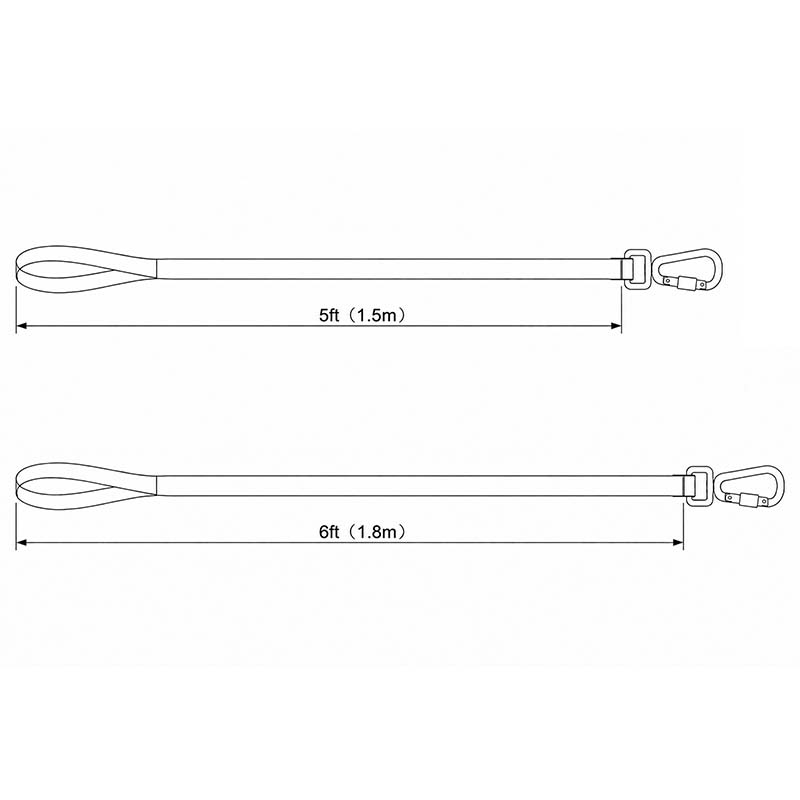
Between 1.5 m and 1.8 m, the difference is 30 cm (approximately 1 ft). Less spare line can be easier to gather, while extra length can provide room for a change of position. Neither option removes the need to manage slack. Compare them in the dog leash length guide.
The FeatherStrong Ultralight model also has a 49 cm (19.3 in) option, measured as webbing length excluding the clip. That short reach serves close-control handling. Check whether it reaches comfortably; it is not the default for a full loose-leash practice session.
Test the grip while using rewards
A handle should feel secure while you gather spare line, change direction, and reach for a reward. Try the grip in the conditions you expect to use it, including gloves if relevant. A slim strap may feel different when tension increases. Choose by handling comfort rather than appearance alone.
Keep loose loops clear of legs and wheels. Do not wrap the leash around your fingers, wrist, or hand. The British Society for Surgery of the Hand (BSSH) describes dog lead injuries caused when a dog’s sudden movement tightens a lead wrapped around the wrist, hand, or fingers. If the handle slips, digs into your hand, or leaves you unable to manage the dog comfortably, reconsider the setup before adding distractions.
Check the collar or harness and the clip together
Follow the collar or harness maker’s fit and attachment instructions. Check that the leash clip fits the designated ring and that its gate can close fully without crowding or interference. Look at the actual closure mechanism: a carabiner-style shape does not, by itself, establish a locking feature or a load rating.
Practice movement with the fitted equipment before progressing to a busier route. For a puppy or a dog that is difficult to manage, get individual fitting and training guidance. Our leash clip and buckle guide explains connection checks.
Where UHMWPE and Aircraft-Grade Aluminum fit
FeatherStrong™ by SOLISZEN pairs UHMWPE webbing with Aircraft-Grade Aluminum. UHMWPE’s high strength-to-weight ratio helps support a slim strap, and the hardware contributes to a compact assembly. These features can appeal when you want less bulk in equipment carried through everyday practice.
Low stretch provides direct handling feedback without bungee cushioning. It does not justify leash corrections. The complete leash includes its handle, stitching, clip, and connections. Material properties cannot establish a finished working load or maximum dog-weight rating. See the UHMWPE material guide for that distinction.
A FeatherStrong option for everyday on-leash practice
The FeatherStrong™ Ultralight UHMWPE Dog Leash is a fixed-length handheld model for one dog. Its listed webbing dimensions are 10 mm × 2.8 mm (approximately 0.39 in × 0.11 in), and it uses an Aircraft-Grade Aluminum carabiner-style clip. Its 1.5 m and 1.8 m versions are listed for everyday on-leash practice.
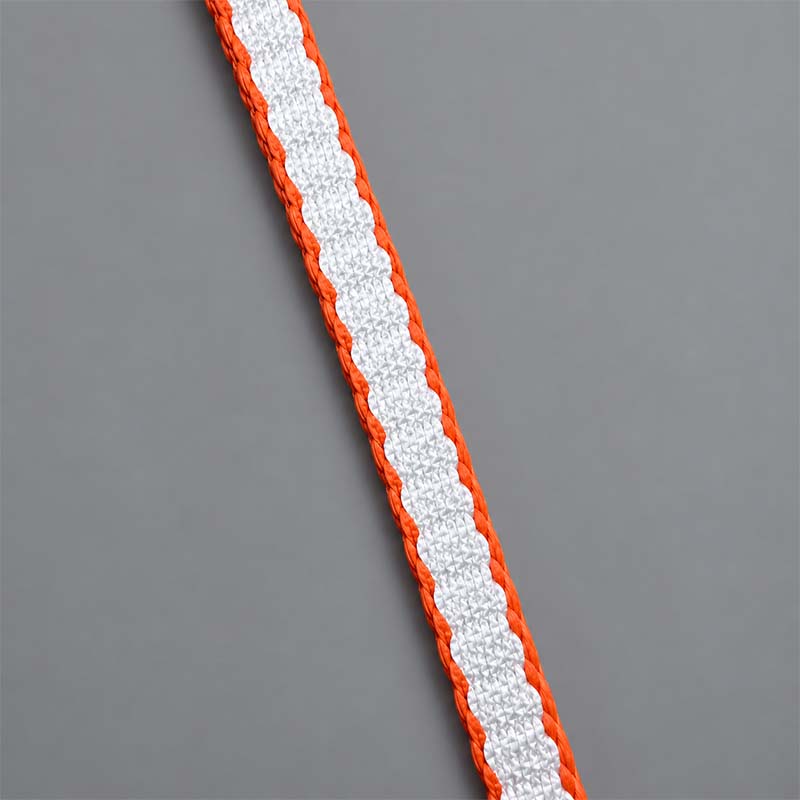
Consider the model when its grip, clip fit, reach, and intended use match your setup. A narrow strap is not automatically limited to small dogs, but width or a webbing-strength figure cannot establish suitability for a powerful dog. No complete-leash working-load or maximum dog-weight rating is specified.
Compare other models in the SOLISZEN dog leash collection using each product’s own details. A similar material name does not make their dimensions or connections interchangeable.
Keep the practice reward-based
The American Veterinary Society of Animal Behavior recommends reward-based training and advises against leash corrections and other aversive methods. Use the leash to manage the connection rather than as a tool for punishment.
The AKC’s linked guide describes marking and rewarding attention, practicing a few steps and turns in a quiet area, and then introducing outdoor distractions gradually. Keep the exercise achievable. If tension keeps building or the dog cannot engage, choose an easier setting and seek help from a qualified reward-based trainer when needed.
Inspect before practice and care afterward
Check both sides and edges of the webbing, the handle, seams, clip, and attachment area. Stop using equipment with damaged critical parts or a gate that cannot close securely. Prevent chewing and inspect any area that drags or catches during the session.
Follow the model’s cleaning instructions. For the Ultralight model, wipe with a damp cloth and air-dry; keep it away from high heat and harsh chemicals. The UHMWPE leash care guide covers inspection and replacement decisions.
Request a length that fits your practice
If standard lengths do not suit the working distance you need, use the custom sizing request guide. Email wendy.soliszen@gmail.com with the model, measurement definition, units, and delivery country. SOLISZEN will confirm feasibility, specifications, price, and lead time. A custom length changes reach; it does not add a no-pull mechanism.
Frequently asked questions
What should I look for in a puppy training leash?
Choose a fixed handheld leash that lets you hold the handle securely while managing slack and rewards. Compare 1.5 m and 1.8 m (approximately 5 ft and 6 ft) by comfortable reach and the practice space. Check that the clip fits the puppy’s collar or harness ring, closes fully without crowding, and does not interfere with comfortable movement. Supervise use, prevent chewing, and recheck equipment fit as the puppy grows.
Preparing to welcome a Maltipoo puppy? Our Maltipoo homecoming guide covers pickup timing and the handover questions to discuss before early walking practice.
Is a 5 ft or 6 ft leash better for training?
Compare 1.5 m (approximately 5 ft) and 1.8 m (approximately 6 ft) by your working space and ability to manage slack. Choose enough reach for comfortable movement without leaving loose line around feet. Check the model and the training task.
Will an UHMWPE leash stop pulling?
No. High-strength webbing is a material feature, not an automatic behavior change. Choose suitable equipment and use a training plan that teaches the walking skills you want.
Can I use this leash for recall training?
You can practice nearby check-ins within an everyday leash’s reach. Distant recall practice requires an appropriate long line, suitable space, and instruction on handling that equipment.
Is it suitable for a puppy that chews the leash?
This textile model is not sold as chew-proof. Prevent biting, supervise use, and replace damaged equipment. Ask a trainer for help with repeated leash biting rather than relying on tensile strength to resist it.
Leave a Reply