Updated
For everyday walks, start with a 1.5–1.8 m dog leash, approximately 5–6 ft. A 90 cm leash, about 3 ft, can be useful when you need your dog close beside you, provided it reaches the attachment point without pulling tight. Choose the length around your route, your dog’s height, and your handling comfort.
If you are comparing 90 cm with 150 cm, the main difference is working room: 90 cm keeps the distance compact, while 150 cm allows more slack for ordinary walking. A 180 cm option adds another 30 cm of room. Here is how to choose between them.
Dog leash length at a glance
| Length | Useful for | Main tradeoff |
|---|---|---|
| 90 cm / about 3 ft | Short transitions, busy entrances, and close walking | Less room to sniff; may be too short for a small dog and tall handler |
| 150 cm / about 5 ft | Everyday neighborhood walks and mixed routes | Enough slack for walking, but still needs shortening near hazards |
| 180 cm / about 6 ft | Quieter paths, more sniffing room, and loose-leash practice | More loose leash to manage around feet, other dogs, and obstacles |
The Edmonton Humane Society recommends a 4–6 ft leash for everyday neighborhood walks. That makes 1.5 m and 1.8 m practical starting points. A shorter leash serves a more specific purpose.
When a 90 cm leash makes sense
A short leash can be convenient between the car and a building, while waiting at a crossing, or when passing through a busy entrance. There is less spare length to gather while your dog stays close.
Check the fit of that working distance before choosing it for a whole walk. With your arm relaxed and your dog beside you, the leash should reach the collar or harness with some slack. If you have to lower your shoulder, bend toward your dog, or keep the leash taut, choose more length.
A 90 cm leash is therefore not automatically a better choice for a small dog. A tall person walking a short dog can need more length than someone walking a much taller dog.
150 cm vs 180 cm: choosing an everyday leash
Choose 150 cm if your usual route mixes sidewalks, crossings, and smaller open areas. It offers room for a relaxed walk without quite as much spare length to gather as 180 cm.
Choose 180 cm if you often walk on quieter paths and can comfortably manage the extra slack. It gives your dog a little more room to change pace or investigate a scent without you following every step.
Neither length needs to stay fully extended throughout the walk. Gather a comfortable amount before approaching traffic or passing other people, then allow more room when the surroundings permit it. Keep loose loops clear of feet and wheels.
Does a shorter leash stop pulling?
No. A shorter leash limits how far a dog can move away, but it does not teach loose-leash walking. Constant tension can leave both of you uncomfortable. A longer leash also needs careful handling: allowing a dog to rush to its end can produce a sudden jolt.
Practice in a quiet place and reward walking with slack in the leash. The American Kennel Club’s leash-training guide explains how to build this skill gradually. If your dog frequently lunges or is difficult to manage, work with a qualified reward-based trainer on an appropriate setup and training plan.
For a large dog, choose a length you can handle while keeping enough distance from distractions. Body size alone does not make 90 cm the right answer.
Length, width, and strength are different decisions
Length controls working distance. Width affects how the leash feels in your hand. The material, construction, stitching, and clip all contribute to how the finished leash performs.
UHMWPE stands for ultra-high-molecular-weight polyethylene. It is a fiber material used where high strength relative to weight matters; Avient describes its fiber properties here. Those material properties help explain why a leash can have a slim profile, but they do not establish a finished leash’s load rating.
A 10 mm leash should not be classified as small-dog-only from its appearance. Equally, width alone cannot confirm suitability for a powerful dog. Check the particular model’s intended use, construction, and handling comfort. A slim strap that feels light when slack may feel quite different in your hand under tension.
The FeatherStrong™ ultralight leash by SOLISZEN uses slim UHMWPE woven webbing. Hardware material: Aircraft-Grade Aluminum. This combination keeps bulk low, while the webbing’s wear resistance is a useful material feature for everyday walking. Check that the clip fits the collar or harness attachment ring and closes fully, and compare each model’s construction and dimensions.
Compare current SOLISZEN options
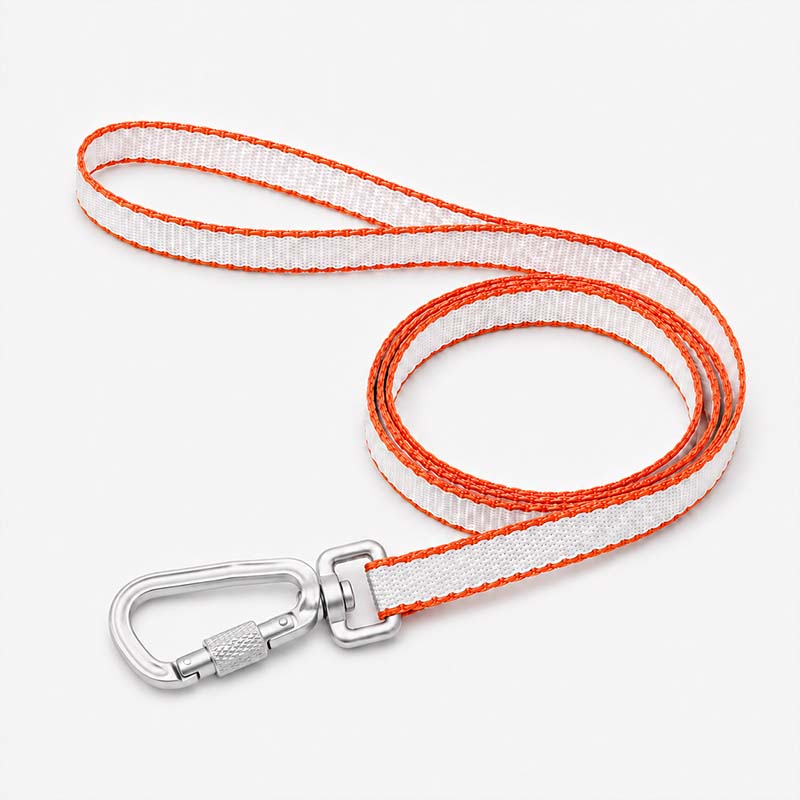
- FeatherStrong Ultralight UHMWPE Dog Leash: 1.5 m and 1.8 m walking options, plus a separate 49 cm option for very short working distances. The 49 cm measurement excludes the metal clip. Check that the shortest version comfortably reaches your dog’s attachment point.
- For walking two compatible dogs, see the FeatherStrong Orange & White UHMWPE Dual Dog Leash, a separate 1.5 m two-dog model. It is not a 90 cm single-dog leash.
Before attaching either, check your dog’s collar fit. Our dog collar measuring guide explains how to measure, read a size chart, and check the fitted collar.
Need a custom leash length?
If the standard lengths do not suit your walking setup, you can request a custom FeatherStrong leash length. Choose a length that gives your dog appropriate working room and feels manageable in your hand.
Use the custom sizing request guide to define the endpoints and units. Then email wendy.soliszen@gmail.com with the product name or link, your requested length and units (cm/in or m/ft), and your delivery country. Specify whether you mean the webbing length or the overall length including the clip and handle. We’ll confirm the available options, pricing, and lead time before you order.
Common questions about leash length
Is 150 cm the same as a 5 ft leash?
It is approximately 5 ft. The exact conversion is 4.92 ft; similarly, 180 cm is approximately 6 ft. Use the manufacturer’s stated metric measurement when comparing closely sized products.
Which length is better for a puppy?
Start with enough length for slack and a clip that suits the puppy’s attachment ring and size. A lightweight everyday leash around 1.5–1.8 m is a useful option to consider. The shortest leash is not necessarily the easiest or most comfortable.
Can I use 180 cm for recall training?
You can practice very short check-ins, but 180 cm is still an everyday walking length. For recall at a distance, use a purpose-built long line in a suitable open area and learn how to handle it safely.
Do I need more than one leash?
Only if different walks call for different equipment. Start with the length that suits your most frequent route. A separate short leash can be useful for specific transitions; it does not have to replace your everyday leash.
Explore SOLISZEN dog leashes and compare the length, webbing, clip, and handle before choosing.
Leave a Reply