Updated
To measure your dog for a collar, wrap a soft tape around the neck where a normal flat collar rests, record the snug neck measurement, and follow the exact product’s size guide. Once fitted, the collar should allow a comfortable two-finger check while remaining secure enough that it cannot slip over the head.
The step that is easy to miss is the chart’s meaning. Some charts list your dog’s neck circumference; others list the collar’s adjustable circumference. Do not add a fixed allowance unless the manufacturer asks for it, and do not add extra room twice.
How to measure your dog’s neck in 4 steps
You need a flexible measuring tape, somewhere to record the result, and a calm moment with your dog. If you do not have a tape, use non-stretch string and a ruler.
- Find the normal collar position. With your dog standing or sitting naturally, place the tape where a standard flat collar normally rests, below the jaw and above the shoulders. Remove the existing collar first.
- Measure without pulling tight. Keep the tape flat around the neck and close to the coat, without a hanging gap or pressure on the neck. Do not measure over clothing or the outside of another collar.
- Write down the snug measurement. Label it “neck circumference” so you know it does not include an added allowance. Repeat the measurement to check that it is consistent.
- Read the selected collar’s instructions. If they ask you to include finger room while measuring, take that second measurement and label it separately. Use the value the chart requests.
These steps apply to ordinary adjustable flat collars. Slip-on collars and martingales can need additional measurements and different fitting instructions.
Should you add inches to the neck measurement?
There is no single allowance to add to every dog or every collar. A fixed extra 2 in (5.1 cm) can make a large difference on a small neck. Adding room to a measurement that already includes finger space can also leave a collar too loose.
| What the chart asks for | What to compare |
|---|---|
| Dog’s neck circumference | Your snug neck measurement, with any adjustment specified by the brand |
| Measurement including finger room | The measurement taken with that allowance already included |
| Collar’s adjustable circumference | The required fitted circumference, following the product’s instructions |
Keep both units if you shop internationally. Divide centimeters by 2.54 to get inches; multiply inches by 2.54 to get centimeters. For example, 30 cm is approximately 11.8 in.
How tight should a dog collar be?
After adjusting and fastening a standard flat collar, you should be able to slip two fingers comfortably underneath without forcing them. Blue Cross includes this check in its dog-training guidance.
Treat the finger check as a practical starting point, not a precise measuring tool: adult finger sizes and dog neck shapes differ. Also check that the collar stays secure, allows normal movement, and does not slide over the head when gently moved forward. Test indoors without jerking the collar or pulling your dog by the neck.
If your dog can back out of a collar despite a careful fit, seek help choosing a suitable setup. Simply tightening an ordinary collar further may not solve the mismatch between neck and head shape.
Choosing a FeatherStrong™ collar size
The two FeatherStrong™ collars by SOLISZEN below use UHMWPE woven webbing. Hardware material: Aircraft-Grade Aluminum. UHMWPE is selected for its high strength relative to weight and wear resistance, while the buckle helps keep hardware weight low. Choose the neck range first, then compare strap width and buckle size for your dog.
The 10 mm FeatherStrong Ultralight Dog Collar and 20 mm FeatherStrong Lightweight Dog Collar currently list the following neck ranges:
| Size | Listed neck range | Available profiles |
|---|---|---|
| S | 22–35 cm / 8.7–13.8 in | 10 mm or 20 mm, depending on the model |
| M | 35–57 cm / 13.8–22.4 in | 10 mm or 20 mm, depending on the model |
For example, a 30 cm (11.8 in) neck falls within the listed S range; a 42 cm (16.5 in) neck falls within M. The fitted collar must still pass the comfort and security checks. A measurement of exactly 35 cm sits at the shared boundary: remeasure and check with SOLISZEN which size leaves useful adjustment for your dog.
Between sizes? Check adjustment before sizing up
Choose a collar that can both loosen enough for comfort and tighten enough to stay secure. When two ranges overlap, compare the remaining adjustment, strap width, and buckle bulk. Do not automatically select the larger size just because your dog is fluffy or still growing.
A puppy needs a secure fit today. Recheck frequently as the puppy grows and after grooming or noticeable body changes. If neither standard size fits comfortably, contact SOLISZEN to discuss a custom collar size or choose a different model. Do not try to make an unsuitable adjustment range work.
Need a custom collar size?
If the listed sizes do not give your dog a comfortable, secure fit, follow the custom sizing request guide to request a FeatherStrong collar size. Start with the neck measurement taken above; do not use breed or body weight as a substitute.
Email wendy.soliszen@gmail.com with the product name or link, your dog’s measured neck circumference and units (cm or in), any preferred adjustment range or strap width, and your delivery country. Say whether your measurement already includes finger room. We’ll confirm the available options, pricing, and lead time before you order.
10 mm vs 20 mm: width is separate from neck size
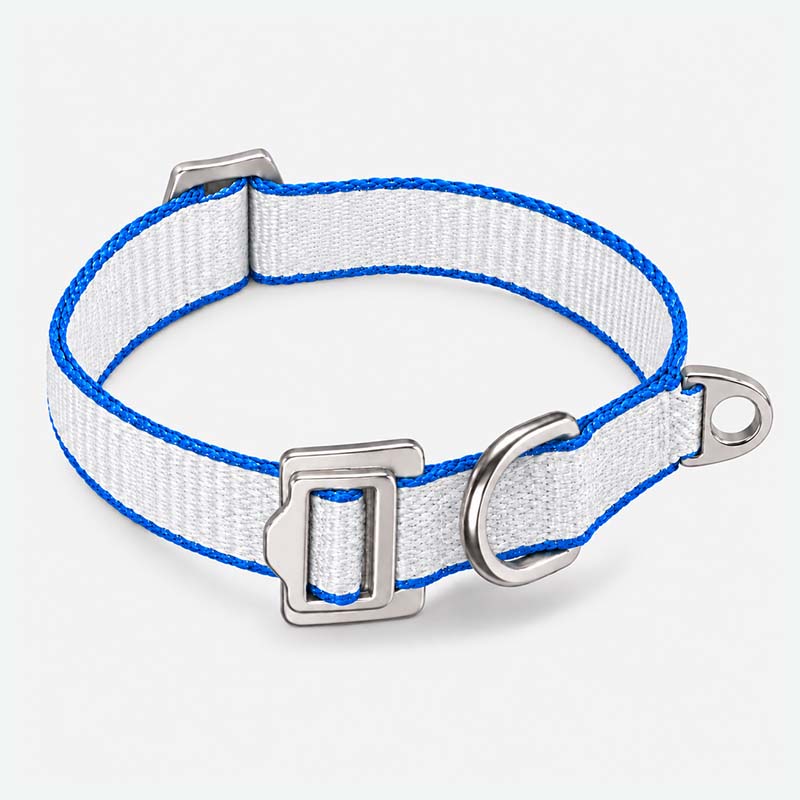
The neck measurement selects the adjustment range. Strap width affects the collar’s profile and contact with the neck. A slim 10 mm design has less visual bulk, while 20 mm gives a broader contact area. Compare the strap profile and buckle size as well as the adjustment range on each product page.
A narrow collar is not automatically limited to small dogs, but material strength alone does not establish comfortable suitability for every large dog. Check the finished design, fit, and how the dog walks. Appearance is a preference; secure fit and comfort are requirements.
For a dog that pulls, increasing material strength does not remove pressure on the neck. A properly fitted walking harness can be an appropriate alternative for leash attachment. The Edmonton Humane Society’s harness guide explains the fit considerations.
Check the collar before the first walk
- Close the buckle fully and check that the adjuster holds its setting.
- Confirm comfortable finger room and check that the collar cannot slip over the head.
- Watch your dog move normally; the collar should not interfere with the jaw or shoulders.
- Check for rubbing after initial use and inspect the webbing, stitching, buckle, and attachment ring.
Stop using the collar if it causes discomfort or if any part is damaged or no longer fastens securely. Recheck fit regularly, especially during growth or after coat changes.
Dog collar sizing questions
Can I measure without a tape measure?
Yes. Wrap non-stretch string around the normal collar position, mark where the ends meet, then measure that length with a ruler. Repeat to check the result.
Can I measure an old collar instead?
Use a well-fitting old collar as a second reference. Its full end-to-end length may include loose strap or buckle parts that do not contribute to the fit. Follow the new brand’s measuring method and confirm your dog’s current neck measurement.
Can I choose collar size by breed or weight?
Use the actual neck measurement. Dogs of the same breed or weight can have different proportions, and S, M, and L labels vary across brands and models.
Once you have the measurement, compare SOLISZEN dog collars. For the rest of your walking setup, see how to choose a dog leash length.
Leave a Reply