Shipping $15 under $60 | Free shipping at $60 or more | Ships from China

Category: Dog Collar Guides

Dog collar sizing, fit, materials, hardware and care guides.

  • Choosing a Lightweight Dog Collar: Width, Fit, and Buckle Weight

    A lightweight dog collar should fit securely and comfortably before you compare width or hardware. Start with your dog’s measured neck circumference, choose an adjustment range that gives useful room in both directions, and then compare the 10 mm and 20 mm profiles. Buckle size and weight matter too, but they should be judged as part of the complete collar.

    Start with fit, not the size label

    Small, medium and large labels are not standardized across brands. Measure the neck where the collar normally rests and compare that number with the exact product’s adjustable range. Our dog collar measuring guide explains how to take the measurement and check the fitted collar.

    The Edmonton Humane Society’s guide to selecting walking gear recommends checking that a collar is neither too loose nor too tight and uses a two-finger fit check. Treat that check as a practical starting point: finger sizes and dog neck shapes vary, so also confirm that the collar does not restrict normal movement or slip over the head.

    10 mm vs 20 mm dog collar width

    Width describes the strap profile, not the neck size. A 10 mm collar has a slimmer visual profile and less strap across the neck. A 20 mm collar provides a broader contact area. Either width still needs the correct neck range, secure adjustment and a buckle that sits comfortably.

    A narrow collar is not automatically for small dogs only, and a wider collar is not automatically the right choice for every large dog. Consider the individual dog’s neck shape, coat, walking behavior and comfort. If your dog pulls hard against a neck collar, review the complete walking setup rather than trying to solve the issue through width alone.

    Compare the current FeatherStrong collar options

    Feature 10 mm Ultralight collar 20 mm Lightweight collar
    Webbing profile 10 mm wide × 2.8 mm thick 20 mm wide × 3.5 mm thick
    Listed S range 22–35 cm (8.7–13.8 in) 22–35 cm (8.7–13.8 in)
    Listed M range 35–57 cm (13.8–22.4 in) 35–57 cm (13.8–22.4 in)
    Hardware material Aircraft-Grade Aluminum Aircraft-Grade Aluminum
    Start your comparison with Measured neck range, then the slimmer profile and buckle fit Measured neck range, then the broader profile and buckle fit

    These are the currently listed options for the FeatherStrong™ Ultralight UHMWPE Dog Collar and the FeatherStrong™ Lightweight UHMWPE Dog Collar. Check the product page again before ordering because availability can change.

    Why buckle weight and shape matter

    A buckle sits on the dog’s neck every time the collar is worn. Its mass, dimensions and position contribute to how the complete collar feels and sits. A lighter hardware material can help control bulk, but the material name alone does not provide the buckle’s exact weight or prove that a finished collar suits a particular dog.

    Both FeatherStrong collars above list Aircraft-Grade Aluminum as the hardware material. When comparing them, check the complete collar rather than estimating from the metal name. Look at the buckle dimensions, how it rests against the neck, whether both sides engage fully, and whether the adjustment stays in place. See our dog leash clip and collar buckle guide for the hardware checks.

    What UHMWPE changes—and what it does not

    The two collars use UHMWPE woven webbing. UHMWPE is selected for high strength relative to fiber weight and abrasion resistance, which can support a slim, low-bulk design. These material properties do not establish a finished collar’s load rating, maximum dog weight or suitability by themselves. Stitching, adjustment, hardware and fit still matter. Our UHMWPE dog leash and collar guide explains this distinction.

    A practical lightweight collar checklist

    • Measure the neck where the collar will sit; do not choose by breed or body weight alone.
    • Confirm that the measured neck falls within the current adjustable range.
    • Choose 10 mm or 20 mm based on the strap profile you want and how it sits on your dog.
    • Check buckle size, position and complete closure rather than the material name alone.
    • Confirm that the leash ring and any identification tag sit without crowding the buckle.
    • Recheck the fit after grooming, coat changes, growth or a noticeable change in body condition.
    • Inspect the webbing, stitching, ring and buckle before use, and stop using the collar if any part is damaged or no longer closes securely.

    When a standard size does not fit

    If neither listed range provides a secure, comfortable fit, use our custom dog collar size request guide. Email wendy.soliszen@gmail.com with the exact product name or link, measured neck circumference, units, preferred adjustment range and width, and delivery country. SOLISZEN will confirm available specifications, price and lead time before you order.

    Common questions

    Is a 10 mm collar only for small dogs?

    No. Width alone does not define the dog’s size or establish suitability. Check the measured neck range, buckle fit, complete construction and how the individual dog uses the collar.

    Is a 20 mm collar always more comfortable?

    No single width is best for every dog. A 20 mm strap provides a broader contact area, while a 10 mm strap has a slimmer profile. The right choice depends on fit, neck shape, coat, movement and the complete collar.

    Does Aircraft-Grade Aluminum tell me the buckle weight?

    No. It identifies the hardware material. Exact buckle weight depends on the specific part’s size and design. Compare model-specific information and the complete collar.

    Can I choose a collar by my dog’s weight?

    Use neck circumference as the starting measurement. Dogs of the same body weight can have different neck shapes and sizes, so body weight does not replace measuring.
  • Custom Dog Leash Lengths and Collar Sizes: How to Request Yours

    A custom dog leash or collar request is easier to review when the measurement definition is clear. Before emailing SOLISZEN, choose the closest product from the FeatherStrong™ range, record the requested dimensions and units, and explain how you measured. SOLISZEN will then confirm whether the specification is available, along with the price and lead time, before you order.

    Check the standard sizes first

    Current FeatherStrong products already cover several common sizes. Availability and prices can change, so use the product page as the current reference.

    Product Current standard options Check before requesting custom sizing
    FeatherStrong™ Ultralight UHMWPE Dog Leash 49 cm (19.3 in), 1.5 m (approximately 5 ft), or 1.8 m (approximately 6 ft) The 49 cm option lists webbing length and excludes the metal clip. State exactly what your requested length should include.
    FeatherStrong™ Ultralight UHMWPE Dog Collar – 10 mm S: 22–35 cm (8.7–13.8 in); M: 35–57 cm (13.8–22.4 in) Measure the neck where the collar will sit and identify the 10 mm profile.
    FeatherStrong™ Lightweight UHMWPE Dog Collar – 20 mm S: 22–35 cm (8.7–13.8 in); M: 35–57 cm (13.8–22.4 in) Measure the neck and identify the 20 mm profile. Width does not change between S and M.

    If one of these options fits, ordering the standard product is usually the clearest path. A custom request is useful when the required leash length or collar adjustment range falls outside the listed options, or when you need SOLISZEN to review a specific measurement.

    How to request a custom dog leash length

    Start with the exact product name or product-page link. Then provide one requested length in centimeters, meters, inches or feet. Do not send a number without a unit.

    Define the endpoints. For example, say whether the requested length is:

    • the webbing only;
    • the webbing plus the dog-side clip;
    • the complete leash from the end of the handle to the end of the clip; or
    • another clearly described measurement.

    Also describe the intended walking situation, such as close handling or ordinary neighborhood walks. This context explains the request, but it does not establish that a length is safe for every dog or environment. Leash width, grip, the dog’s pulling behavior, connection points and the complete product still matter.

    For help comparing common lengths before requesting a custom option, read How Long Should a Dog Leash Be?

    How to request a custom dog collar size

    Measure the dog’s current neck circumference where the collar will normally rest. Use a flexible measuring tape, keep it level and allow the same comfortable space you want under the finished collar. Record the actual fitted measurement rather than choosing by breed or body weight.

    In the email, state whether the number is the dog’s neck circumference, an existing collar measurement or a preferred adjustable range. These are different measurements and should not be treated as interchangeable. If you measured an existing collar, describe the two points you measured between.

    Include the preferred webbing width or link to the closest product. The current FeatherStrong range includes 10 mm and 20 mm collar profiles. A width preference does not by itself determine suitability; fit, the dog’s behavior and complete construction also matter.

    Growing puppies and dogs whose coat changes substantially should be measured again close to ordering. See How to Measure Dog Collar Size for the full measuring and fit guide.

    What to include in your email

    Information Dog leash request Dog collar request
    Product Product name or link, color preference if relevant Product name or link, preferred width and color if relevant
    Measurement Requested length and exact endpoints Current neck circumference and preferred adjustable range
    Units cm, m, in or ft cm or in
    Context Intended walking situation and any handling requirement Where the neck was measured; puppy or major coat change if relevant
    Delivery Destination country Destination country

    Email template for a leash request

    Subject: FeatherStrong Custom Leash Length Request

    Product name or link:
    Color preference:
    Requested length:
    Unit:
    The requested length includes:
    Intended walking situation:
    Delivery country:
    Other details:

    Email template for a collar request

    Subject: FeatherStrong Custom Collar Size Request

    Product name or link:
    Preferred width and color:
    Measured neck circumference:
    Unit:
    How and where I measured:
    Preferred adjustable range, if known:
    Delivery country:
    Other details:

    Send the request to SOLISZEN

    Email wendy.soliszen@gmail.com. A request does not create an order and does not guarantee that every size, color or configuration can be made. Wait for SOLISZEN to confirm the specification, current availability, price, handling time and estimated delivery information before placing or paying for an order.

    FeatherStrong products use UHMWPE webbing and Aircraft-Grade Aluminum hardware. These material names do not establish a finished-product working-load rating or a maximum dog weight. If a tested load rating is essential for your dog or use case, ask what model-specific evidence is available before ordering.

    Common questions

    Can I request any leash length or collar size?

    You can ask, but availability must be confirmed. Materials, hardware, construction limits and current production options may affect what can be made.

    Should I send both metric and imperial measurements?

    One clear unit is enough. You may include both, but label each value and make sure the conversion refers to the same measurement.

    Is a custom-size request the same as an order?

    No. The email starts a specification review. The size, price and lead time need to be confirmed before an order is placed.

    Can I choose a custom size based only on my dog’s weight?

    No. For a collar, measure the neck where the collar will sit. For a leash, define the required length and consider handling, pulling behavior, connection points and the walking environment.

  • Aircraft-Grade Aluminum: Dog Leash Clips and Collar Buckles

    For the webbing side of the system, see our UHMWPE dog leash and collar material guide.

    Aircraft-Grade Aluminum can help reduce hardware bulk in a dog leash or collar, but the material name is only the starting point. A leash clip still needs to close fully and fit the collar or harness ring. A collar buckle still needs to latch securely and sit comfortably. Webbing, stitching, connection points and the complete product matter alongside the metal.

    Why use aluminum for dog gear hardware?

    Aluminum is widely used where low weight matters. The Aluminum Association describes aluminum as lightweight and corrosion resistant, while the Australian Aluminium Council explains that aluminum can weigh about one-third as much as a same-size, same-shape piece of steel.

    That general material advantage can help designers control the weight of clips and buckles. It does not mean that two parts with different shapes, dimensions or mechanisms will have the same strength. It also does not establish a working-load limit for a finished dog leash or collar.

    A leash clip and collar buckle do different jobs

    A leash clip connects the leash to a suitable ring on a collar or harness. The opening must clear the ring, the gate must close completely and the attached webbing must remain secure. A light clip can be useful on a slim leash, provided the whole setup suits the individual dog and walking conditions.

    A collar buckle closes the collar around the neck. Its shape and weight affect how the collar sits, while the adjustable range determines whether the collar fits. A metal buckle does not replace measuring the neck. Veterinary guidance from VCA Animal Hospitals emphasizes secure fit and notes that a loose collar can allow a dog to escape.

    What should you check before choosing?

    Check Leash clip Collar buckle
    Opening and closure Confirm the gate opens smoothly and returns to a fully closed position. Confirm both sides engage completely and release as intended.
    Connection and fit Make sure the opening and body fit the collar or harness ring without crowding the release. Measure the neck and check the full adjustable range, strap width and buckle position.
    Hardware weight Compare the complete leash, not the clip material alone. Consider how the buckle and other hardware sit on the dog’s neck.
    Evidence Ask for the exact model’s test conditions if a rated load is important. Do not infer a collar load rating from the buckle material.

    What does Aircraft-Grade Aluminum tell you?

    For the FeatherStrong™ products linked below, Aircraft-Grade Aluminum identifies the hardware material. The wording does not by itself claim that the finished leash or collar is certified for aircraft use, nor does it state an alloy number, clip weight, buckle weight or finished-product load rating.

    Those missing details should not be guessed from appearance. If a specific hardware weight or load rating matters, request information for the exact product, size and configuration. A fiber data sheet or a general aluminum property cannot replace evidence for the assembled item.

    FeatherStrong hardware examples

    Product Webbing profile Hardware material
    FeatherStrong™ Ultralight UHMWPE Dog Leash 10 mm wide × 2.8 mm thick Aircraft-Grade Aluminum
    FeatherStrong™ Ultralight UHMWPE Dog Collar 10 mm wide × 2.8 mm thick Aircraft-Grade Aluminum
    FeatherStrong™ Lightweight UHMWPE Dog Collar 20 mm wide × 3.5 mm thick Aircraft-Grade Aluminum

    The 10 mm profile is slim, but width alone does not identify which dog can use a leash or collar. For a leash, consider pulling behavior, handling comfort, clip fit and the complete construction. For a collar, start with neck circumference and then compare the adjustable range, width and buckle fit. See the FeatherStrong dog leash and collar range for current sizes.

    Inspect hardware before every walk

    • Open and close the clip or buckle and confirm that it returns to its intended closed position.
    • Look for cracks, bending, sharp edges, unusual looseness or a closure that no longer aligns.
    • Inspect the webbing and stitching where they join the hardware.
    • Check that the leash clip is attached to the intended collar or harness ring.
    • Stop using the item if any part is damaged or no longer closes securely.

    Keep the complete item clean according to its product instructions and let it dry before storage. Corrosion resistance is useful, but it does not make every assembled leash or collar waterproof or maintenance-free.

    Need a different size?

    If a standard leash length or collar range does not fit your needs, follow the custom sizing request guide, then email wendy.soliszen@gmail.com with the product name or link, requested measurements and units, and your delivery country. For a leash, say whether the requested length includes the clip and handle. For a collar, include the measured neck circumference and preferred adjustment range. SOLISZEN will confirm available specifications, price and lead time before you order.

    Common questions

    Is Aircraft-Grade Aluminum automatically stronger than steel hardware?

    No. Material, alloy, dimensions, shape and manufacturing all affect a component. Compare evidence for the specific part or finished product rather than ranking hardware by a material name alone.

    Does a lightweight clip make a leash suitable for a small dog?

    Hardware weight is one consideration. Also check the complete leash weight, clip fit, handling, the dog’s behavior and the walking environment.

    Can a 10 mm leash be used for a large dog?

    Width alone cannot answer that. A slim UHMWPE profile may provide the appearance you want, but the fiber name and width do not establish a finished-product rating. Consider the individual dog’s pulling behavior, your grip, all connection points and any model-specific test information.

  • UHMWPE Dog Leashes and Collars: Benefits and What to Check

    UHMWPE can be a useful webbing material for dog leashes and collars when you want a slim, lightweight design. Its fiber properties are only one part of the choice: the finished leash also has a handle, seams and clip, while a collar has an adjustable fit, buckle and connection ring. Choose the complete item for your dog and your walking routine.

    What is UHMWPE?

    UHMWPE stands for ultra-high-molecular-weight polyethylene. It names a material family, not a finished leash rating or a guarantee that every webbing product performs alike. Avient’s overview of UHMWPE fiber describes a high strength-to-weight ratio and abrasion resistance. Those are useful reasons to consider the material for woven dog gear, but they do not tell you how an assembled product was made or tested.

    Three material benefits, with their limits

    Strength relative to fiber weight. UHMWPE fiber can provide high strength without a bulky fiber mass. That supports a low-profile design, but a 10 mm strap is not automatically suitable for a particular dog. Stitching, hardware, handling and the intended use still matter.

    Abrasion resistance. The fiber is resistant to surface wear. It is still important to inspect webbing edges, stitched areas and metal connections. Abrasion resistance does not mean a leash is chew-proof, cut-proof or safe to use after damage.

    Low fiber moisture uptake. Avient reports very low moisture regain for its UHMWPE fiber. This is a fiber property; water can remain around a finished item’s seams and hardware. Follow the care instructions for your specific leash or collar and let it dry before storage.

    Why leash width and collar width mean different things

    On a leash, width affects the feel of the strap in your hand and its visual profile. A narrower leash may suit the look you want, yet handling comfort matters if your dog pulls. The handle design, length and clip must be considered with the webbing.

    On a collar, width affects how the strap sits against your dog’s neck. Start with a measured neck circumference and a secure, comfortable adjustment range. Compare buckle size and the way the collar sits on your dog. A collar’s neck-size range and strap width answer separate questions; neither is a load rating.

    FeatherStrong™ by SOLISZEN currently offers a 10 mm-wide, 2.8 mm-thick UHMWPE leash, a 10 mm-wide, 2.8 mm-thick collar, and a 20 mm-wide, 3.5 mm-thick collar. The two collars each list adjustable S (22–35 cm / 8.7–13.8 in) and M (35–57 cm / 13.8–22.4 in) neck ranges. Hardware material: Aircraft-Grade Aluminum. Check the current product page for the exact configuration you select.

    What to verify on the finished product

    Material data from a fiber supplier cannot substitute for a finished leash or collar test. If a pulling-load rating matters to your purchase, ask for model-specific evidence and test conditions. Do not convert a yarn strength figure into a maximum dog weight. Check that the leash clip fits your collar or harness attachment point and closes fully; check that the collar buckle adjusts securely and that the collar fits the measured neck.

    Dog size alone does not settle the choice. A 10 mm leash is not automatically limited to small dogs, and the fiber name alone cannot establish suitability for a large dog. Consider the particular dog’s pulling behavior, your grip and the complete product. If the available product information does not answer a safety or fit question, ask before ordering.

    Next steps

    Explore the FeatherStrong™ dog leash and collar range to compare current models. Use our leash length guide to compare walking reach and our collar fit guide to measure the neck. For the Ultralight leash’s cleaning and inspection instructions, read the UHMWPE Dog Leash Care & Buying Guide. Need a nonstandard length or collar size? Read the custom sizing request guide, then email wendy.soliszen@gmail.com with the model, measurement and units, your dog’s typical walking behavior and your delivery country. We will confirm available specifications, price and lead time before an order.

    Common questions

    Does UHMWPE mean the leash is waterproof?

    No. Low moisture uptake by the fiber does not certify the whole leash, its stitching or its hardware as waterproof.

    Can a wider collar replace measuring my dog?

    No. Width changes how the collar sits on the neck; the adjustable size range still needs to fit the measured neck. See the collar measuring guide.

  • How to Measure Your Dog for a Collar: Size & Fit Guide

    How to Measure Your Dog for a Collar: Size & Fit Guide

    To measure your dog for a collar, wrap a soft tape around the neck where a normal flat collar rests, record the snug neck measurement, and follow the exact product’s size guide. Once fitted, the collar should allow a comfortable two-finger check while remaining secure enough that it cannot slip over the head.

    The step that is easy to miss is the chart’s meaning. Some charts list your dog’s neck circumference; others list the collar’s adjustable circumference. Do not add a fixed allowance unless the manufacturer asks for it, and do not add extra room twice.

    How to measure your dog’s neck in 4 steps

    You need a flexible measuring tape, somewhere to record the result, and a calm moment with your dog. If you do not have a tape, use non-stretch string and a ruler.

    1. Find the normal collar position. With your dog standing or sitting naturally, place the tape where a standard flat collar normally rests, below the jaw and above the shoulders. Remove the existing collar first.
    2. Measure without pulling tight. Keep the tape flat around the neck and close to the coat, without a hanging gap or pressure on the neck. Do not measure over clothing or the outside of another collar.
    3. Write down the snug measurement. Label it “neck circumference” so you know it does not include an added allowance. Repeat the measurement to check that it is consistent.
    4. Read the selected collar’s instructions. If they ask you to include finger room while measuring, take that second measurement and label it separately. Use the value the chart requests.

    These steps apply to ordinary adjustable flat collars. Slip-on collars and martingales can need additional measurements and different fitting instructions.

    Should you add inches to the neck measurement?

    There is no single allowance to add to every dog or every collar. A fixed extra 2 in (5.1 cm) can make a large difference on a small neck. Adding room to a measurement that already includes finger space can also leave a collar too loose.

    What the chart asks forWhat to compare
    Dog’s neck circumferenceYour snug neck measurement, with any adjustment specified by the brand
    Measurement including finger roomThe measurement taken with that allowance already included
    Collar’s adjustable circumferenceThe required fitted circumference, following the product’s instructions
    If the chart does not explain its measurements, ask the seller before choosing a boundary size.

    Keep both units if you shop internationally. Divide centimeters by 2.54 to get inches; multiply inches by 2.54 to get centimeters. For example, 30 cm is approximately 11.8 in.

    How tight should a dog collar be?

    After adjusting and fastening a standard flat collar, you should be able to slip two fingers comfortably underneath without forcing them. Blue Cross includes this check in its dog-training guidance.

    Treat the finger check as a practical starting point, not a precise measuring tool: adult finger sizes and dog neck shapes differ. Also check that the collar stays secure, allows normal movement, and does not slide over the head when gently moved forward. Test indoors without jerking the collar or pulling your dog by the neck.

    If your dog can back out of a collar despite a careful fit, seek help choosing a suitable setup. Simply tightening an ordinary collar further may not solve the mismatch between neck and head shape.

    Choosing a FeatherStrong™ collar size

    The two FeatherStrong™ collars by SOLISZEN below use UHMWPE woven webbing. Hardware material: Aircraft-Grade Aluminum. UHMWPE is selected for its high strength relative to weight and wear resistance, while the buckle helps keep hardware weight low. Choose the neck range first, then compare strap width and buckle size for your dog.

    The 10 mm FeatherStrong Ultralight Dog Collar and 20 mm FeatherStrong Lightweight Dog Collar currently list the following neck ranges:

    SizeListed neck rangeAvailable profiles
    S22–35 cm / 8.7–13.8 in10 mm or 20 mm, depending on the model
    M35–57 cm / 13.8–22.4 in10 mm or 20 mm, depending on the model
    These ranges apply to the two linked FeatherStrong models. Always confirm the current size guide on the product you order.

    For example, a 30 cm (11.8 in) neck falls within the listed S range; a 42 cm (16.5 in) neck falls within M. The fitted collar must still pass the comfort and security checks. A measurement of exactly 35 cm sits at the shared boundary: remeasure and check with SOLISZEN which size leaves useful adjustment for your dog.

    Between sizes? Check adjustment before sizing up

    Choose a collar that can both loosen enough for comfort and tighten enough to stay secure. When two ranges overlap, compare the remaining adjustment, strap width, and buckle bulk. Do not automatically select the larger size just because your dog is fluffy or still growing.

    A puppy needs a secure fit today. Recheck frequently as the puppy grows and after grooming or noticeable body changes. If neither standard size fits comfortably, contact SOLISZEN to discuss a custom collar size or choose a different model. Do not try to make an unsuitable adjustment range work.

    Need a custom collar size?

    If the listed sizes do not give your dog a comfortable, secure fit, follow the custom sizing request guide to request a FeatherStrong collar size. Start with the neck measurement taken above; do not use breed or body weight as a substitute.

    Email wendy.soliszen@gmail.com with the product name or link, your dog’s measured neck circumference and units (cm or in), any preferred adjustment range or strap width, and your delivery country. Say whether your measurement already includes finger room. We’ll confirm the available options, pricing, and lead time before you order.

    10 mm vs 20 mm: width is separate from neck size

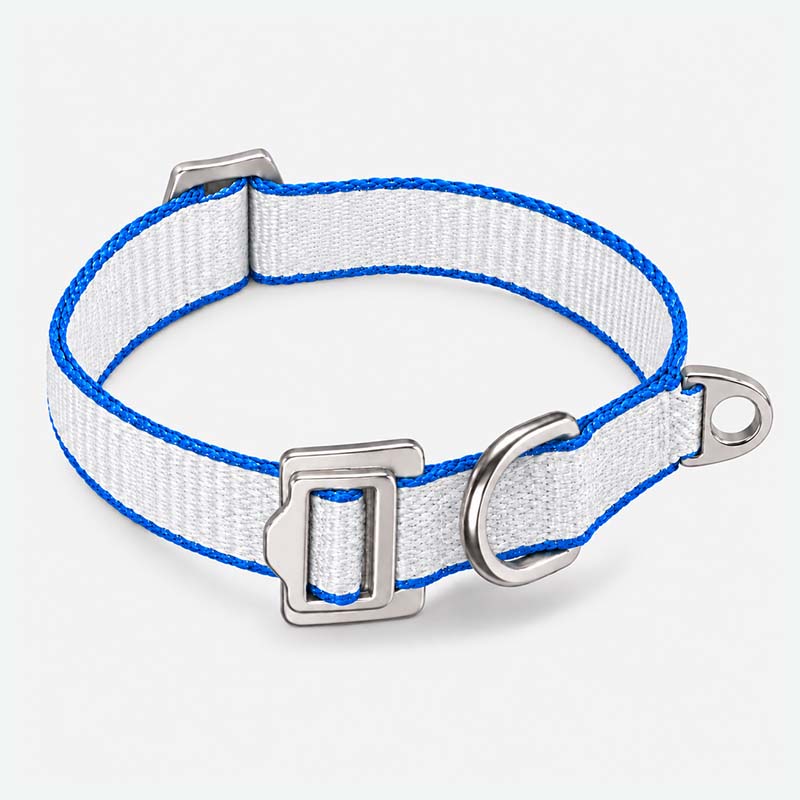
    White and blue FeatherStrong 20 mm UHMWPE dog collar; buckle material: Aircraft-Grade Aluminum
    The 20 mm FeatherStrong collar has a wider strap profile; measure neck circumference separately when selecting S or M.

    The neck measurement selects the adjustment range. Strap width affects the collar’s profile and contact with the neck. A slim 10 mm design has less visual bulk, while 20 mm gives a broader contact area. Compare the strap profile and buckle size as well as the adjustment range on each product page.

    A narrow collar is not automatically limited to small dogs, but material strength alone does not establish comfortable suitability for every large dog. Check the finished design, fit, and how the dog walks. Appearance is a preference; secure fit and comfort are requirements.

    For a dog that pulls, increasing material strength does not remove pressure on the neck. A properly fitted walking harness can be an appropriate alternative for leash attachment. The Edmonton Humane Society’s harness guide explains the fit considerations.

    Check the collar before the first walk

    • Close the buckle fully and check that the adjuster holds its setting.
    • Confirm comfortable finger room and check that the collar cannot slip over the head.
    • Watch your dog move normally; the collar should not interfere with the jaw or shoulders.
    • Check for rubbing after initial use and inspect the webbing, stitching, buckle, and attachment ring.

    Stop using the collar if it causes discomfort or if any part is damaged or no longer fastens securely. Recheck fit regularly, especially during growth or after coat changes.

    Dog collar sizing questions

    Can I measure without a tape measure?

    Yes. Wrap non-stretch string around the normal collar position, mark where the ends meet, then measure that length with a ruler. Repeat to check the result.

    Can I measure an old collar instead?

    Use a well-fitting old collar as a second reference. Its full end-to-end length may include loose strap or buckle parts that do not contribute to the fit. Follow the new brand’s measuring method and confirm your dog’s current neck measurement.

    Can I choose collar size by breed or weight?

    Use the actual neck measurement. Dogs of the same breed or weight can have different proportions, and S, M, and L labels vary across brands and models.

    Once you have the measurement, compare SOLISZEN dog collars. For the rest of your walking setup, see how to choose a dog leash length.