US shipping $9 · Other destinations $15 · Free shipping $84+ · Ships from China

Author: wendy, One_number

  • UHMWPE Dog Leashes and Collars: Benefits and What to Check

    UHMWPE can be a useful webbing material for dog leashes and collars when you want a slim, lightweight design. Its fiber properties are only one part of the choice: the finished leash also has a handle, seams and clip, while a collar has an adjustable fit, buckle and connection ring. Choose the complete item for your dog and your walking routine.

    What is UHMWPE?

    UHMWPE stands for ultra-high-molecular-weight polyethylene. It names a material family, not a finished leash rating or a guarantee that every webbing product performs alike. Avient’s overview of UHMWPE fiber describes a high strength-to-weight ratio and abrasion resistance. Those are useful reasons to consider the material for woven dog gear, but they do not tell you how an assembled product was made or tested.

    Three material benefits, with their limits

    Strength relative to fiber weight. UHMWPE fiber can provide high strength without a bulky fiber mass. That supports a low-profile design, but a 10 mm strap is not automatically suitable for a particular dog. Stitching, hardware, handling and the intended use still matter.

    Abrasion resistance. The fiber is resistant to surface wear. It is still important to inspect webbing edges, stitched areas and metal connections. Abrasion resistance does not mean a leash is chew-proof, cut-proof or safe to use after damage.

    Low fiber moisture uptake. Avient reports very low moisture regain for its UHMWPE fiber. This is a fiber property; water can remain around a finished item’s seams and hardware. Follow the care instructions for your specific leash or collar and let it dry before storage.

    For a dog-leash-focused explanation of low stretch, bending fatigue, weather resistance, and everyday handling, read why UHMWPE makes sense for a lightweight dog leash.

    Why leash width and collar width mean different things

    Product What width affects
    Leash

    On a leash, width affects the feel of the strap in your hand and its visual profile. A narrower leash may suit the look you want, yet handling comfort matters if your dog pulls. The handle design, length and clip must be considered with the webbing.

    Collar

    On a collar, width affects how the strap sits against your dog’s neck. Start with a measured neck circumference and a secure, comfortable adjustment range. Compare buckle size and the way the collar sits on your dog. A collar’s neck-size range and strap width answer separate questions; neither is a load rating.

    Representative FeatherStrong™ models include the FeatherStrong™ Ultralight UHMWPE Dog Leash with 10 mm-wide, 2.8 mm-thick webbing, the FeatherStrong™ Ultralight UHMWPE Dog Collar – 10 mm, White & Orange, and the FeatherStrong™ Lightweight UHMWPE Dog Collar – 20 mm, White & Blue. These two reference collars list adjustable S (22–35 cm / 8.7–13.8 in) and M (35–57 cm / 13.8–22.4 in) neck ranges. Hardware material: Aircraft-Grade Aluminum. Browse the current UHMWPE dog leash collection and UHMWPE dog collar collection, then check the selected product page for its exact configuration.

    What to verify on the finished product

    Material data from a fiber supplier cannot substitute for a finished leash or collar test. If a pulling-load rating matters to your purchase, ask for model-specific evidence and test conditions. Do not convert a yarn strength figure into a maximum dog weight. Check that the leash clip fits your collar or harness attachment point and closes fully; check that the collar buckle adjusts securely and that the collar fits the measured neck.

    Dog size alone does not settle the choice. A 10 mm leash is not automatically limited to small dogs, and the fiber name alone cannot establish suitability for a large dog. Consider the particular dog’s pulling behavior, your grip and the complete product. If the available product information does not answer a safety or fit question, ask before ordering.

    Next steps

    Explore the FeatherStrong™ dog leash and collar range to compare current models. Use our leash length guide to compare walking reach and our collar fit guide to measure the neck. For the Ultralight leash’s cleaning and inspection instructions, read the UHMWPE Dog Leash Care & Buying Guide. Need a nonstandard length or collar size? Read the custom sizing request guide, then email wendy.soliszen@gmail.com with the model, measurement and units, your dog’s typical walking behavior and your delivery country. We will confirm available specifications, price and lead time before an order.

    Common questions

    Does UHMWPE mean the leash is waterproof?

    No. Low moisture uptake by the fiber does not certify the whole leash, its stitching or its hardware as waterproof.

    Can a wider collar replace measuring my dog?

    No. Width changes how the collar sits on the neck; the adjustable size range still needs to fit the measured neck. See the collar measuring guide.
  • UHMWPE Dog Leash Care & Buying Guide

    A UHMWPE dog leash should be chosen as a complete piece of walking equipment, not by its fiber name alone. Check the length, webbing, stitching and clip together, then keep the leash clean and inspect it before each walk. This guide covers the current FeatherStrong Ultralight model and explains which questions are worth asking before buying a lightweight leash.

    What does UHMWPE mean?

    For a fuller explanation of the webbing material, read our UHMWPE dog leash and collar guide. UHMWPE stands for ultra-high-molecular-weight polyethylene. Avient describes UHMWPE fiber as lightweight and abrasion-resistant, with a high strength-to-weight ratio. These are material characteristics, not a test certificate for a finished dog leash. See Avient’s UHMWPE fiber overview for general material background.

    A finished leash also includes seams, connections and hardware. A material description does not tell you the complete leash’s working load, the strength of its stitching or a safe maximum dog weight. Likewise, a metal material name is not a finished-product load rating. Our Aircraft-Grade Aluminum hardware guide explains what to check on clips and buckles.

    Five things to check before buying

    1. Length and measurement method. Choose a length that comfortably reaches your dog’s collar or harness attachment point. Ask whether the stated length includes the clip.
    2. Complete weight. Compare grams for the same leash length, including the handle and metal clip. The word “ultralight” alone does not provide that comparison.
    3. Webbing dimensions and handling. Check width and thickness, and consider how the handle will feel during your normal walks.
    4. Finished-product evidence. Ask for model-specific test conditions and results if you need a rated load. Do not substitute a fiber supplier’s data sheet for a test of the assembled leash.
    5. Clip compatibility. Check that the gate closes fully and that the connection fits the collar or harness you intend to use.

    Start with the setting and your dog’s walking behavior. A 10 mm leash is not automatically limited to small dogs, and the same width does not establish that a finished leash is suitable for a large dog. For a lighter setup, see our small-dog leash guide. If your dog pulls hard, read the large-dog leash guide for grip, connection and finished-product questions. Neither guide assigns a safe dog-weight limit from webbing width or material alone.

    If the standard length does not match your route or handling preference, use our custom sizing request guide to describe the model, desired length, whether the measurement includes the clip and handle, your units, and delivery country. SOLISZEN can confirm available specifications, pricing and lead time before an order.

    Cleaning the FeatherStrong Ultralight leash

    For ordinary surface dirt, wipe this model with a damp cloth and let it air-dry before putting it away. Keep it away from chewing, uncontrolled heat and harsh chemicals. Do not burn fibers to check the material, or use a flame to repair a damaged edge. This page does not authorize machine washing, tumble drying, boiling, solvent cleaning or a particular disinfectant.

    If dirt or a sticky substance cannot be removed with the published care method, contact SOLISZEN before trying another cleaner. Chemical tolerance can depend on concentration, temperature and exposure time; Samson discusses these variables in its general rope-cleaning guidance. Its instructions concern Samson ropes and are not a certification or cleaning approval for this leash.

    Inspect the whole leash before the next walk

    Look along the webbing and both sides of the stitched areas. Stop using the leash if you find cut fibers, damaged seams, a loose connection, cracked or bent hardware, or a gate that will not close securely. Do not cover damage with tape and assume the original strength has been restored. If its condition is uncertain, set it aside and ask for advice.

    Inspect after an unusual snag, a chewing incident or visible damage as well as before normal use. Routine inspection matters even with abrasion-resistant fibers; general background is available in Samson’s rope-care resources. Industrial rope wear percentages and retirement thresholds should not be transferred to a pet leash.

    Caring for a UHMWPE collar

    Do not assume every UHMWPE collar has the same cleaning instructions as this leash. Check the care guidance for the specific collar model before using a cleaner or washing method. After a walk, inspect the webbing edges, stitching, adjustment area, buckle closure and attachment ring. Set the collar aside if a closure no longer holds securely, a connection is loose or the webbing is visibly damaged. Ask SOLISZEN about model-specific cleaning when the published instructions do not cover the problem.

    Fit is part of routine care: recheck the collar when your dog grows, changes coat or shows rubbing. Our collar measurement guide explains how to measure neck circumference, and the lightweight collar guide compares width, fit and buckle considerations. A light material does not compensate for a poor fit or damaged closure.

    Choosing this model’s length

    The FeatherStrong Ultralight UHMWPE Dog Leash uses 10 mm-wide, 2.8 mm-thick webbing and an Aircraft-Grade Aluminum clip. It is available in White & Orange and White & Green.

    Length option Use and measurement notes
    49 cm close control; this measurement excludes the metal clip.
    1.5 m / approximately 5 ft everyday walking with closer handling.
    1.8 m / approximately 6 ft more walking room where the surroundings allow it.

    See our dog leash length guide for more help. This is a single-dog walking model, not climbing, lifting, fall-arrest or unattended tie-out equipment. No finished-product maximum dog-weight or load rating is currently published for this model.

    Sources explain general fiber and rope-care principles; they do not imply that Avient or Samson supplied, tested or endorsed this SOLISZEN product.

  • How to Measure Your Dog for a Collar: Size & Fit Guide

    How to Measure Your Dog for a Collar: Size & Fit Guide

    To measure your dog for a collar, wrap a soft tape around the neck where a normal flat collar rests, record the snug neck measurement, and follow the exact product’s size guide. Once fitted, the collar should allow a comfortable two-finger check while remaining secure enough that it cannot slip over the head.

    The step that is easy to miss is the chart’s meaning. Some charts list your dog’s neck circumference; others list the collar’s adjustable circumference. Do not add a fixed allowance unless the manufacturer asks for it, and do not add extra room twice.

    How to measure your dog’s neck in 4 steps

    You need a flexible measuring tape, somewhere to record the result, and a calm moment with your dog. If you do not have a tape, use non-stretch string and a ruler.

    1. Find the normal collar position. With your dog standing or sitting naturally, place the tape where a standard flat collar normally rests, below the jaw and above the shoulders. Remove the existing collar first.
    2. Measure without pulling tight. Keep the tape flat around the neck and close to the coat, without a hanging gap or pressure on the neck. Do not measure over clothing or the outside of another collar.
    3. Write down the snug measurement. Label it “neck circumference” so you know it does not include an added allowance. Repeat the measurement to check that it is consistent.
    4. Read the selected collar’s instructions. If they ask you to include finger room while measuring, take that second measurement and label it separately. Use the value the chart requests.

    These steps apply to ordinary adjustable flat collars. Slip-on collars and martingales can need additional measurements and different fitting instructions.

    Should you add inches to the neck measurement?

    There is no single allowance to add to every dog or every collar. A fixed extra 2 in (5.1 cm) can make a large difference on a small neck. Adding room to a measurement that already includes finger space can also leave a collar too loose.

    What the chart asks forWhat to compare
    Dog’s neck circumferenceYour snug neck measurement, with any adjustment specified by the brand
    Measurement including finger roomThe measurement taken with that allowance already included
    Collar’s adjustable circumferenceThe required fitted circumference, following the product’s instructions
    If the chart does not explain its measurements, ask the seller before choosing a boundary size.

    Keep both units if you shop internationally. Divide centimeters by 2.54 to get inches; multiply inches by 2.54 to get centimeters. For example, 30 cm is approximately 11.8 in.

    How tight should a dog collar be?

    After adjusting and fastening a standard flat collar, you should be able to slip two fingers comfortably underneath without forcing them. Blue Cross includes this check in its dog-training guidance.

    Treat the finger check as a practical starting point, not a precise measuring tool: adult finger sizes and dog neck shapes differ. Also check that the collar stays secure, allows normal movement, and does not slide over the head when gently moved forward. Test indoors without jerking the collar or pulling your dog by the neck.

    If your dog can back out of a collar despite a careful fit, seek help choosing a suitable setup. Simply tightening an ordinary collar further may not solve the mismatch between neck and head shape.

    Choosing a FeatherStrong™ collar size

    The two FeatherStrong™ collars by SOLISZEN below use UHMWPE woven webbing. Hardware material: Aircraft-Grade Aluminum. UHMWPE is selected for its high strength relative to weight and wear resistance, while the buckle helps keep hardware weight low. Choose the neck range first, then compare strap width and buckle size for your dog.

    The 10 mm FeatherStrong Ultralight Dog Collar and 20 mm FeatherStrong Lightweight Dog Collar currently list the following neck ranges:

    SizeListed neck rangeAvailable profiles
    S22–35 cm / 8.7–13.8 in10 mm or 20 mm, depending on the model
    M35–57 cm / 13.8–22.4 in10 mm or 20 mm, depending on the model
    These ranges apply to the two linked FeatherStrong models. Always confirm the current size guide on the product you order.

    For example, a 30 cm (11.8 in) neck falls within the listed S range; a 42 cm (16.5 in) neck falls within M. The fitted collar must still pass the comfort and security checks. A measurement of exactly 35 cm sits at the shared boundary: remeasure and check with SOLISZEN which size leaves useful adjustment for your dog.

    Between sizes? Check adjustment before sizing up

    Choose a collar that can both loosen enough for comfort and tighten enough to stay secure. When two ranges overlap, compare the remaining adjustment, strap width, and buckle bulk. Do not automatically select the larger size just because your dog is fluffy or still growing.

    A puppy needs a secure fit today. Recheck frequently as the puppy grows and after grooming or noticeable body changes. If neither standard size fits comfortably, contact SOLISZEN to discuss a custom collar size or choose a different model. Do not try to make an unsuitable adjustment range work.

    Need a custom collar size?

    If the listed sizes do not give your dog a comfortable, secure fit, follow the custom sizing request guide to request a FeatherStrong collar size. Start with the neck measurement taken above; do not use breed or body weight as a substitute.

    Email wendy.soliszen@gmail.com with the product name or link, your dog’s measured neck circumference and units (cm or in), any preferred adjustment range or strap width, and your delivery country. Say whether your measurement already includes finger room. We’ll confirm the available options, pricing, and lead time before you order.

    10 mm vs 20 mm: width is separate from neck size

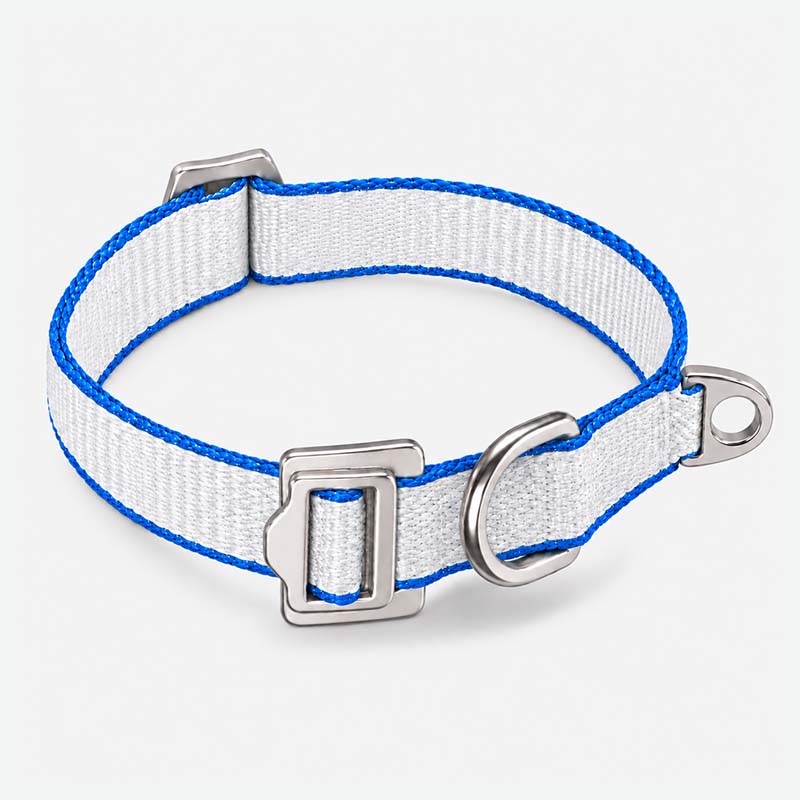
    White and blue FeatherStrong 20 mm UHMWPE dog collar; buckle material: Aircraft-Grade Aluminum
    The 20 mm FeatherStrong collar has a wider strap profile; measure neck circumference separately when selecting S or M.

    The neck measurement selects the adjustment range. Strap width affects the collar’s profile and contact with the neck.

    Strap widthProfile and contact
    10 mmA slim 10 mm design has less visual bulk.
    20 mm20 mm gives a broader contact area.

    Compare the strap profile and buckle size as well as the adjustment range on each product page.

    A narrow collar is not automatically limited to small dogs, but material strength alone does not establish comfortable suitability for every large dog. Check the finished design, fit, and how the dog walks. Appearance is a preference; secure fit and comfort are requirements.

    For a dog that pulls, increasing material strength does not remove pressure on the neck. A properly fitted walking harness can be an appropriate alternative for leash attachment. The Edmonton Humane Society’s harness guide explains the fit considerations.

    Check the collar before the first walk

    • Close the buckle fully and check that the adjuster holds its setting.
    • Confirm comfortable finger room and check that the collar cannot slip over the head.
    • Watch your dog move normally; the collar should not interfere with the jaw or shoulders.
    • Check for rubbing after initial use and inspect the webbing, stitching, buckle, and attachment ring.

    Stop using the collar if it causes discomfort or if any part is damaged or no longer fastens securely. Recheck fit regularly, especially during growth or after coat changes.

    Dog collar sizing questions

    Can I measure without a tape measure?

    Yes. Wrap non-stretch string around the normal collar position, mark where the ends meet, then measure that length with a ruler. Repeat to check the result.

    Can I measure an old collar instead?

    Use a well-fitting old collar as a second reference. Its full end-to-end length may include loose strap or buckle parts that do not contribute to the fit. Follow the new brand’s measuring method and confirm your dog’s current neck measurement.

    Can I choose collar size by breed or weight?

    Use the actual neck measurement. Dogs of the same breed or weight can have different proportions, and S, M, and L labels vary across brands and models.

    Once you have the measurement, compare SOLISZEN dog collars. For the rest of your walking setup, see how to choose a dog leash length.