US shipping $9 · Other destinations $15 · Free shipping $84+ · Ships from China

Category: Dog Leash Guides

Leash selection, sizing, training, materials and care guides for safer everyday walks.

  • How to Choose a Dog Leash for Hiking: Length, Grip, and Trail Checks

    Choose a hiking dog leash by checking the trail rules first, then matching the leash length, grip, structure, and attachment to the route and your dog’s behavior. A fixed leash around 1.5 m (5 ft) can reduce spare line on tighter paths, while 1.8 m (6 ft) offers about 30 cm (1 ft) more room where the trail and local rules allow it. Material matters, but the safest decision comes from the complete leash, the collar or harness connection, the terrain, and the handler’s ability to manage slack.

    Hiking dog leash choices at a glance

    Trail condition What to prioritize Length consideration
    Narrow path, switchbacks, or frequent passing Predictable distance, limited spare line, secure grip About 1.5 m (5 ft), if permitted and comfortable
    More open, low-traffic trail Managed slack, visibility, room to adjust pace Up to 1.8 m (6 ft), subject to trail rules
    Rocky, rooted, or steep ground Stable footing, pace cues, line kept away from legs and obstacles Use only as much reach as you can manage safely
    Wet, muddy, or gritty route Grip, clean closure, post-hike inspection and air-drying Length should not create uncontrolled dragging or snagging
    Wildlife, dogs, or hikers nearby Close response, attention, secure attachment Shorten your practical handling distance before passing

    Check the trail rules before choosing a leash

    “Dog-friendly” does not mean every trail in an area accepts dogs or allows the same leash length. Parks, protected areas, and local authorities can restrict pet access, require a leash, or set a maximum length. Check the official rules for the exact trail before leaving home and keep the leash within that limit throughout the hike.

    The U.S. National Park Service advises hikers to check each park’s pet rules and generally keep dogs on a 6 ft leash. A 1.8 m leash is approximately 6 ft, but the specified metric length and a local legal limit may not be identical after rounding. Follow the rule as written for the place you are visiting.

    Match leash length to the path

    A 1.5 m (approximately 5 ft) leash can be easier to manage where the path is narrow, the route changes direction often, or other hikers pass nearby. Less spare line can reduce the amount that may loop around a leg, root, or trail object. It does not remove the need to manage slack and position.

    A 1.8 m (approximately 6 ft) leash gives roughly 30 cm (about 1 ft) more room for a dog to adjust pace and investigate the edge of a suitable path. That extra space is useful only when the route is visible, the dog stays responsive, and the handler can shorten the practical distance before a blind corner, crossing, wildlife encounter, or narrow section.

    A 49 cm (19.3 in) short leash is designed for close-control handling, not as the default for an entire hike. On uneven ground it may create an awkward position or continuous tension if the dog and handler cannot move comfortably together. Compare measurement methods and use cases in the dog leash length guide.

    Grip matters when the ground changes

    Test the handle with the footwear, gloves, and hand position you expect to use. A narrow, lightweight handle can reduce bulk, but it may not feel comfortable for every person or every dog. The handler must be able to hold it securely without wrapping the leash around the hand, wrist, or fingers.

    On roots, rocks, steps, or wet leaves, slow down before the dog reaches the obstacle. Loose-leash walking and simple pace cues can help the dog move with the handler rather than pull ahead on uneven ground. A leash cannot compensate for poor footing, a route beyond the dog’s fitness, or a handler who cannot maintain control.

    Choose fixed reach over unmanaged extension

    A fixed-length leash keeps the maximum distance predictable. That can simplify slack management around trees, brush, hikers, and dogs. A retractable leash adds a spool, brake, changing line length, and the possibility of thin tape or cord crossing the path. If you use one, the dog should already have reliable leash manners and the open space must support the extra reach.

    For a typical on-leash hike, the more useful question is not “Which leash gives the most freedom?” It is “How much distance can I manage on this route without losing a secure grip or letting the line snag, drag, or cross another trail user?” For the wider format decision, see the fixed vs. retractable dog leash guide.

    UHMWPE and Aircraft-Grade Aluminum on the trail

    Current FeatherStrong™ hiking-compatible fixed models use UHMWPE webbing and Aircraft-Grade Aluminum hardware. UHMWPE supports a slim, low-bulk design and is selected for abrasion resistance and low stretch. Aircraft-Grade Aluminum keeps hardware material in the lightweight product system.

    These material characteristics do not prove the safe load of the assembled leash, its suitability for a specific dog, or an aviation certification. The webbing, handle, stitching, connection points, clip, and collar or harness attachment must work as one system. Read the UHMWPE dog leash and collar guide and the hardware guide for the evidence and inspection boundaries.

    Inspect before, during, and after the hike

    1. Before: check the entire webbing or rope, stitching, handle, clip, gate, and collar or harness attachment. Confirm that the gate closes fully and cannot slip through or crowd the attachment point.
    2. During: pause after a hard snag, fall, chewing incident, or unexpected load. Look for cuts, pulled fibers, loosened stitching, bent hardware, or a gate that does not close securely.
    3. After: remove dirt with the care method published for the model, let the leash air-dry, and inspect it again before storage. Wet or muddy gear should not be put away without checking.

    Abrasion resistance does not make a leash immune to sharp rock, repeated dragging, chewing, or damaged hardware. Replace the leash if any critical part is cut, heavily worn, loose, cracked, bent, or unreliable. The UHMWPE dog leash care and buying guide provides a fuller inspection checklist.

    A current FeatherStrong hiking option

    The FeatherStrong™ Ultralight UHMWPE Dog Leash is a fixed-length handheld leash for one dog. It uses 10 mm-wide × 2.8 mm-thick UHMWPE webbing and an Aircraft-Grade Aluminum carabiner-style clip.

    For suitable trails, the current 1.5 m (approximately 5 ft) and 1.8 m (approximately 6 ft) versions are the relevant hiking choices. The product page states approximately 1,300 kgf / 12.7 kN for the webbing only. That figure is not a breaking-strength or working-load rating for the complete leash and is not a maximum dog-weight rating. Check the finished assembly, the dog’s behavior and pulling force, the connection, and your grip.

    You can also compare the current SOLISZEN dog leash collection. Use only a model whose structure, length, handle, and connection match the planned route.

    What else belongs in the hiking kit?

    A leash is one part of trail preparation. Bring water and a suitable bowl, waste bags, identification, and supplies appropriate to the weather, terrain, distance, and local guidance. Check whether the dog is fit for the planned route and speak with a veterinarian when health, age, heat, altitude, or endurance is a concern.

    Driving to the trailhead? Plan equipment for both parts of the outing. Our guide to walking leashes versus car restraints explains the ride, the parked-car transfer, and the walk after arrival.

    Keep the dog away from wildlife, give other trail users space, and stay on permitted routes. Training cues and recall can help if the leash is accidentally dropped, but they do not replace leash rules or physical control.

    Custom length requests

    If the standard length does not match a specific on-leash route, email wendy.soliszen@gmail.com with the product model, exact measurement definition, unit, and delivery country. SOLISZEN will confirm whether the requested specification is feasible, along with the price and lead time.

    Frequently asked questions

    Is a 5 ft or 6 ft leash better for hiking?

    A 1.5 m (approximately 5 ft) leash reduces spare length on tighter paths. A 1.8 m (approximately 6 ft) leash provides about 30 cm (1 ft) more room on suitable open paths. Follow the trail’s leash rule and choose the distance you can manage safely.

    Should I use a retractable leash for hiking?

    It depends on the location, training, and line management. A fixed-length leash keeps maximum reach predictable around obstacles and other trail users. A retractable leash should be considered only where rules permit it, the space is open, and the dog already has reliable leash manners.

    Is UHMWPE waterproof?

    UHMWPE has low moisture absorption, but a finished leash also includes stitching, connections, and hardware. After wet use, clean it according to the product guidance, allow it to air-dry, and inspect the complete leash.

    Is this leash for climbing or fall protection?

    No. It is pet-walking equipment for supervised use. Do not use it for climbing, lifting, fall arrest, human safety, vehicle restraint, or unattended tie-outs.
  • Fixed vs. Retractable Dog Leash: Which Fits Your Walk?

    A fixed-length leash is usually the clearer choice when you need a predictable distance from your dog, especially on sidewalks, near traffic, around other dogs, or during loose-leash training. A retractable leash can provide more roaming space in a quiet, open area after the dog has reliable leash manners and the handler can manage the brake, line, and surroundings. Neither format is best for every walk. Choose according to the route, the dog’s behavior and training, the handler’s grip, and the complete leash system.

    Fixed vs. retractable dog leash at a glance

    Walking question Fixed-length leash Retractable leash
    How is distance managed? The leash has a set length, so the maximum reach stays predictable. Tape or cord feeds from a spool; a brake or lock limits additional extension.
    Where is it often easier to use? Sidewalks, busier routes, close handling, and structured training. Quiet, open areas with space and few people, dogs, obstacles, or traffic.
    What does the handler manage? Grip, slack, position, and the fixed amount of line. Grip, brake timing, changing line length, visibility, and possible tangling.
    Can it teach a dog not to pull? No. It can give the handler a consistent setup for training, but training changes behavior. No. Allowing line to extend when the dog pulls can reinforce pulling for more distance.
    Main inspection points Handle, webbing or rope, stitching, clip, and attachment point. Handle, brake and lock, spool operation, tape or cord, clip, and attachment point.

    What is the practical difference?

    A fixed-length leash has no spool. Its stated length sets the maximum distance between the handler end and the dog-side attachment, subject to the manufacturer’s measurement method. Because that distance does not change during the walk, the handler can anticipate how much reach is available.

    A retractable leash stores tape or cord inside a handle. The line extends as the dog moves away, and the handler uses a brake or lock to stop more line from feeding out. The reel takes up slack, but it does not pull back a dog that is actively pulling. To shorten the distance, the dog must move closer or the handler must safely regain position and slack.

    This structural difference matters more than a simple “short versus long” label. A fixed 1.8 m (approximately 6 ft) leash and a retractable leash locked at a similar distance still feel different because one is a single fixed line and the other includes a handle, spool, brake, and changing line tension.

    Choose a fixed-length leash when distance must stay predictable

    A fixed-length leash is generally easier to manage when the dog should remain within a consistent range. Common examples include sidewalks, crossings, parking areas, veterinary visits, crowded paths, and places where dogs or people may pass closely. It also gives loose-leash training a repeatable setup: the available distance does not increase simply because the dog pulls.

    The correct fixed length still depends on the route. A very short leash can keep a dog close, but it must comfortably reach the collar or harness without forcing an awkward handler posture or continuous tension. A 1.5 m (about 5 ft) or 1.8 m (about 6 ft) leash gives more walking room, and the extra 30 cm (about 1 ft) can matter on narrow or open routes. Use the dog leash length guide to compare these choices before selecting a model.

    Consider a retractable leash only where extra roaming space can be managed

    A retractable leash can be useful for a leash-trained dog exploring a quiet, open area with good visibility. The handler should release only the amount of line that the setting allows and should know how the brake and lock work before entering that setting.

    It is a poor fit when the dog needs to stay beside the handler, when traffic is nearby, or where the extended line can cross people, dogs, posts, or other obstacles. Do not allow the dog to run at speed until the line stops abruptly. Never grab moving tape or cord with a bare hand; friction and line tension can cause injury.

    Training and pulling change the answer

    Leash structure does not teach polite walking by itself. A fixed-length leash can make the boundary more consistent, while rewards, timing, position, and gradual practice teach the behavior. A retractable leash can make early training harder if pulling immediately produces more distance.

    If a dog lunges or pulls strongly, do not choose from material names or leash width alone. Review the dog’s behavior, the handler’s ability, the collar or harness, every connection, and any model-specific finished-product test information. SOLISZEN does not publish a working-load, breaking-strength, or maximum dog-weight rating for the FeatherStrong™ Ultralight model, so this article does not rate it for a strong puller.

    Materials and hardware still matter, but they do not decide the format

    Fixed and retractable describe how leash length is managed. They do not identify one material. A fixed leash may use flat webbing or round rope, and a retractable design may use tape or cord.

    FeatherStrong™ fixed-length leashes use UHMWPE in current models, with Aircraft-Grade Aluminum hardware. UHMWPE can support a slim, low-bulk design, and Aircraft-Grade Aluminum keeps hardware material in the product decision. These material names do not provide a finished-product load rating, a dog-weight limit, or an aviation certification. Read the UHMWPE vs. nylon dog leash comparison for the material decision and the hardware guide for closure and connection checks.

    Check the complete leash before every walk

    1. Match the structure to the route. Decide whether the dog needs a predictable fixed distance or whether the location safely supports controlled extra reach.
    2. Confirm the length and measurement method. Check whether the stated figure includes clips or other hardware.
    3. Test the handle and controls. The grip should feel secure. On a retractable leash, verify that the brake, lock, and retraction operate smoothly before use.
    4. Inspect the line and connections. Stop using the leash if the webbing, rope, tape, cord, stitching, casing, clip, or gate is cut, loose, cracked, bent, jammed, or no longer closes securely.
    5. Check the collar or harness attachment. The clip must close fully and fit the attachment point without crowding or side-loading.

    For cleaning, storage, replacement signs, and buying questions, use the UHMWPE dog leash care and buying guide.

    A verified fixed-length FeatherStrong option

    The FeatherStrong™ Ultralight UHMWPE Dog Leash is a fixed-length, single-dog walking leash. It uses 10 mm-wide × 2.8 mm-thick flat UHMWPE webbing and an Aircraft-Grade Aluminum clip. Current choices are 49 cm (19.3 in), 1.5 m (approximately 5 ft), and 1.8 m (approximately 6 ft). The 49 cm measurement is the webbing length and excludes the clip.

    Choose the model and length only after checking your route, handling position, dog behavior, collar or harness connection, and the complete product. You can also browse the current SOLISZEN dog leash collection.

    Custom length requests

    If a standard fixed length does not fit your walking setup, email wendy.soliszen@gmail.com with the product model, the exact measurement definition, the unit, and the delivery country. SOLISZEN will confirm whether the requested specification is feasible, along with the price and lead time.

    Frequently asked questions

    Is a fixed leash always better than a retractable leash?

    No. A fixed leash gives a predictable distance and is usually easier for close handling and structured training. A retractable leash may suit a leash-trained dog in a quiet, open area when the handler can manage the line and brake safely.

    Can I lock a retractable leash and use it like a fixed leash?

    Locking limits additional extension, but the handle, spool, brake, line tension, and casing remain part of the setup. Check the complete device rather than treating it as identical to a fixed-length leash.

    Which leash is better for a dog that pulls?

    A leash alone does not stop pulling. A fixed-length leash can provide a consistent distance for training, while a retractable leash can reward pulling if pulling releases more line. Strong pulling also requires model-specific equipment assessment and a suitable collar or harness.

    Is the FeatherStrong leash chew-proof or no-pull?

    No textile leash should be treated as chew-proof, and this fixed-length leash does not automatically prevent pulling. Supervise use, keep the leash away from chewing, inspect it before each walk, and pair equipment with appropriate training.

  • What Is the Best Material for a Dog Leash?

    For an everyday dog leash, choose the material around the weight, feel, care, and handling you want—then check the complete construction. UHMWPE deserves a place on the shortlist when low weight and low stretch matter. Nylon, polyester, leather, and coated webbing offer other useful combinations.

    Buying your first leash? Use our beginner’s guide to choosing a first dog leash to work through the route, length, connection fit, and grip before making a material decision.

    Picture the part of a walk you notice most. Is the spare leash bulky in your bag? Do the edges bother your hand? Does muddy equipment take too much effort to clean? Those questions give a material comparison a practical purpose.

    This guide compares five common choices and explains where a lightweight UHMWPE dog leash fits.

    Dog leash materials at a glance

    Material Why consider it? What deserves a closer look?
    UHMWPE fiber webbing or rope High strength relative to fiber weight, very low moisture uptake, and low fiber elongation Complete leash weight, handle feel, terminations, stitching, and clip fit
    Nylon webbing or rope A familiar textile option with a wide range of constructions Reference nylon fibers take up more moisture and generally elongate more than reference UHMWPE; judge the finished design
    Polyester webbing or rope Low fiber moisture uptake with a different balance of strength and elongation Weave, texture, hardware, and evidence for the actual model
    Leather A distinctive strap feel that some handlers prefer Leather quality, edges, thickness, connections, and the maker’s cleaning and conditioning instructions
    Coated webbing A coated surface can make routine wiping easier The core, coating type, surface grip, attachment construction, and product-specific care

    The fiber distinctions are summarized from the Atkins & Pearce fiber information chart. It compares reference fiber grades, including branded examples; it does not identify the yarn supplier in a SOLISZEN leash or rank five finished products.

    UHMWPE: a useful starting point for lightweight strength

    UHMWPE stands for ultra-high-molecular-weight polyethylene. FIBER-LINE’s technical overview describes a fiber with high strength relative to weight, low density, abrasion resistance, and very low moisture regain.

    These properties give designers room to build a slim textile connection. Whether the finished leash is light and comfortable also depends on the amount of textile, the handle, and the fittings.

    Low fiber elongation can suit a design where little lengthening is wanted. It does not mean zero deformation or built-in cushioning. Abrasion resistance is useful, too, while concentrated tooth damage remains a separate problem.

    For a deeper explanation of the material in a walking setup, see why UHMWPE makes sense for a lightweight dog leash.

    The UHMWPE dog leash and collar guide provides a broader overview of how these material questions apply to both products.

    Nylon and polyester: compare the actual construction

    A nylon leash may be a sensible choice when a particular handle, width, finish, or price suits your routine. Its material label alone cannot describe the experience of holding it.

    The reference chart shows lower moisture regain for polyester than for nylon, and different elongation ranges across their grades. That helps explain material behavior; it cannot predict how quickly a complete leash will dry.

    Ask the same questions of each candidate: What is the finished weight? How are the ends joined? Does the handle fit your hand? Does the clip match the attachment ring? Meaningful answers are more useful than an isolated fiber name.

    Leather: make room for personal preference and care

    Some handlers like the surface and feel of a leather strap. Others prefer a woven or padded handle. The American Kennel Club’s leash guide recognizes those differences in preference and advises different care for leather and nylon.

    Before choosing leather, inspect the edge finish and connections, and read the maker’s maintenance instructions. A material you enjoy holding still needs to suit the cleaning routine you can maintain.

    Coated webbing: look at the surface and the core

    Coated webbing combines a textile core with an outer coating. As one manufacturer example, BioThane describes its branded material as polyester webbing with a TPU or PVC coating and provides cleaning guidance.

    That makes coated construction worth exploring when easy wiping is a priority. Check the specific product’s surface, flexibility, edges, and connections. BioThane is a brand; its specifications should not be assigned to every unbranded coated strap.

    Compare material and leash shape separately

    A round leash can be made from different fibers, just as a flat strap can. Thickness, braid, weave, and handle design change how much material you hold and how it gathers for carrying.

    Feel the contact surfaces you will actually use: the broad face and edges of a strap, or the diameter and texture of a rope. Neither profile establishes a universal comfort winner. Our rope vs. flat dog leash guide explores those construction choices.

    A lightweight UHMWPE example from FeatherStrong

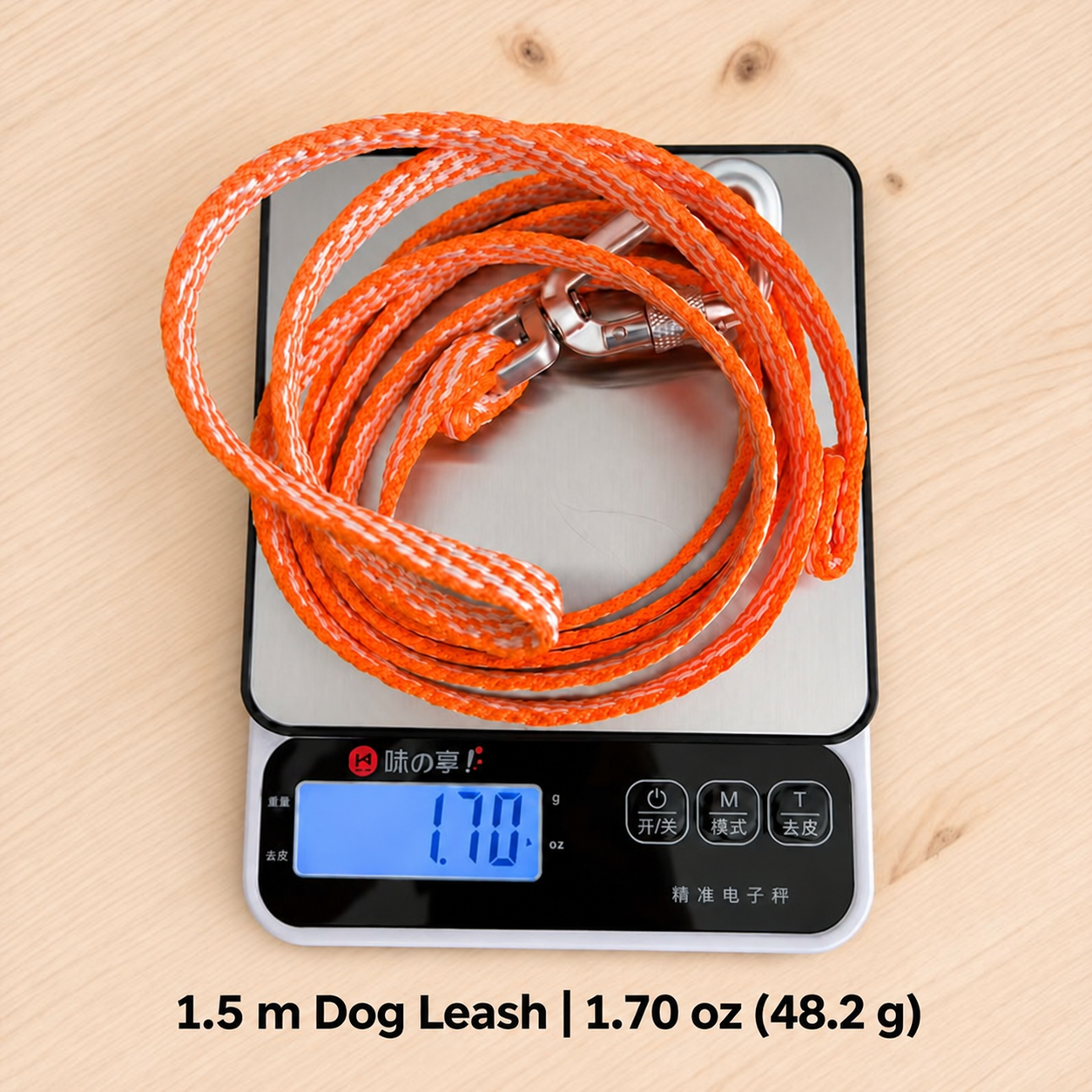
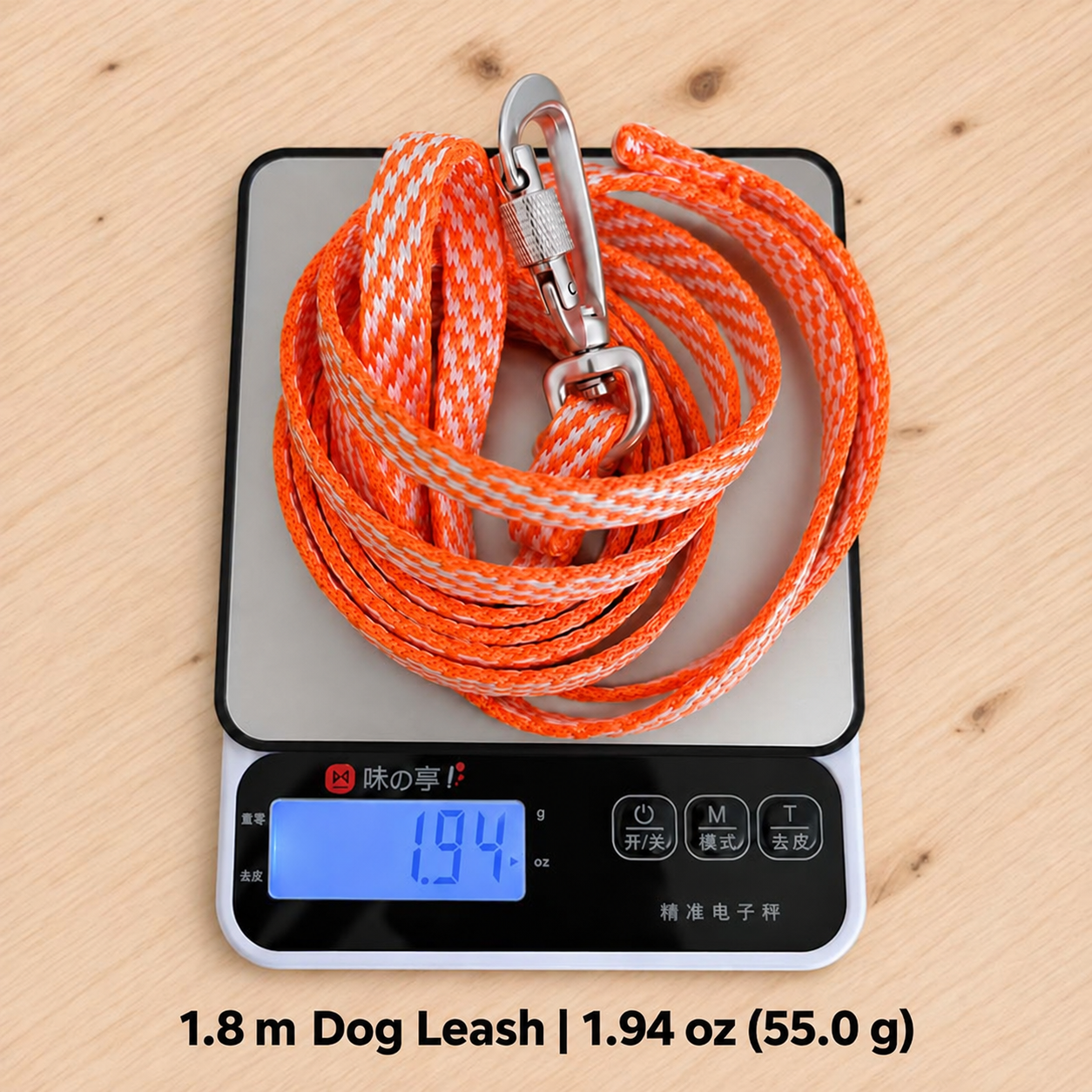
    The FeatherStrong™ Lightweight Woven UHMWPE Dog Leash – Orange & White uses 11.2 × 2.6 mm webbing, approximately 0.44 × 0.10 in, with Aircraft-Grade Aluminum hardware.

    Listed length Complete leash shown in the product’s scale photograph
    1.5 m / approximately 5 ft 1.70 oz / approximately 48.2 g
    1.8 m / approximately 6 ft 1.94 oz / approximately 55.0 g

    The 1.5 m orange-and-white woven leash with its clip on a scale reading 1.70 oz.

    The 1.8 m orange-and-white woven leash with its clip on a scale reading 1.94 oz.

    These listing photographs show individual samples with their clips. They are not a production weight tolerance or a matched comparison with another brand.

    FeatherStrong™ by SOLISZEN is one option to review after deciding your required length, grip, and attachment fit. A supplied webbing test does not establish a working-load or maximum dog-weight rating for the complete leash.

    Other constructions to compare

    FeatherStrong also offers an 8 mm UHMWPE rope leash, an Ultralight flat-webbing leash, and a Green UHMWPE dog leash. Use these as construction examples; their dimensions and material names do not establish a finished-product strength ranking.

    Check the parts the material name cannot describe

    Look along the edges, folded connections, stitching, handle, and hardware. Check that the gate closes fully without being crowded by the collar or harness ring. Hardware material is one consideration alongside its shape, closure, and connection; the leash clip and buckle guide explains those checks.

    Before purchase, confirm the intended use and care instructions. After use, clean as directed and air-dry before storage. Low fiber moisture uptake does not prevent water or dirt from remaining between yarns or around fittings. See the care and inspection guide.

    The hardware is half of the material story

    A leash can use advanced webbing and still be limited by an unsuitable clip or connection. FeatherStrong™ leashes pair UHMWPE webbing or rope with Aircraft-Grade Aluminum hardware to control hardware weight as part of the complete design.

    The Aluminum Association notes that aluminum-alloy density and properties vary by composition. A lower-density material can reduce hardware weight when the part is designed appropriately. The name Aircraft-Grade Aluminum does not by itself establish an alloy number, aviation certification, clip strength, or finished leash rating. Check the actual clip size, gate, swivel, surface, attachment fit, and product evidence.

    Aircraft-Grade Aluminum vs. conventional zinc-alloy hardware

    Hardware materialMaterial considerations
    Conventional zinc alloysZinc alloys are widely used for die-cast components and can form detailed shapes with established finishing options.
    Aircraft-Grade AluminumAircraft-Grade Aluminum can offer lower hardware weight, but material name alone does not prove that every aluminum clip is stronger or more durable than every zinc-alloy clip.

    Geometry, manufacturing, gate design, surface treatment, wear, and the complete connection matter. See the Aircraft-Grade Aluminum leash clip and collar buckle guide for a focused hardware checklist.

    Pulling and chewing: what the leash can and cannot do

    For a dog that pulls, review the complete walking setup: leash, handle, connections, clip, compatible collar or harness, verified product information, the handler’s grip, and the dog’s behavior. Without model-specific testing, material properties do not justify a claim that a leash is rated for powerful pulling.

    An UHMWPE textile leash should not be called chew-proof. Abrasion resistance is different from resistance to concentrated tooth damage. Keep the leash away from unsupervised chewing, and stop using it if you find cuts, pulled or severed fibers, heavy fuzzing, glazing, loose stitching, deformation, or connection damage.

    A “no-pull dog leash” does not automatically stop pulling. Loose-leash walking is a trained behavior, and equipment must be fitted and used correctly. The leash manages connection and distance; it does not replace training.

    For a focused look at textile, seams, fittings, and test scope, read what matters in a strong lightweight dog leash.

    Choose the material, then choose your setup

    Use the comparison to narrow your options. Next, compare complete products at a useful length, including the handle and clip. The leash length guide can help with that decision.

    If standard sizing does not suit your setup, request a review at wendy.soliszen@gmail.com. Include:

    • Product model
    • Measurement endpoints or definition
    • Measurement and units
    • Delivery country

    SOLISZEN will confirm feasible specifications, price, and lead time before a customized order.

    The custom length and collar size request guide explains how to describe the measurement.

    Frequently asked questions

    Is UHMWPE better than every other dog leash material?

    It has a useful combination for lightweight, low-stretch designs. The best complete leash for you also depends on grip, construction, care, length, attachment fit, and intended use.

    Which material feels softest?

    A material name cannot settle that question. Weave, surface finish, edges, thickness, padding, and handle shape all affect the experience. Softness, easy bending, and lengthening under tension are different properties.

    For a model-focused look at handling and complete weights, see the soft, lightweight dog leash guide.

    Is polyester the same as nylon?

    They are different fiber families. Their reference properties differ, while the weave and complete construction remain important in a leash.

    Does a tougher material stop pulling or chewing?

    A leash provides a connection; it does not teach loose-leash walking. Do not assume a textile leash is chew-proof. Supervise use and replace damaged equipment.

    Is a 10 mm UHMWPE leash suitable for a large dog?

    Width alone cannot answer that question. Check the exact construction, product-specific evidence, clip and connection fit, dog behavior, route, and handling needs.

    Can a walking leash be used for a pulling sport?

    Ordinary walking or calm running differs from Canicross and other pulling sports. Check the specific equipment, connection system, intended use, and handling requirements. A fixed walking leash is not specialized pulling equipment by material name alone.

  • Rope vs Flat Dog Leash: Grip, Bulk, and Handling

    A rope dog leash and a flat dog leash can use the same fiber but feel different in the hand because their profiles are different. Neither shape is automatically better. Compare the complete leash, grip profile, bulk, length, clip fit, visible wear, and the individual dog’s behavior before choosing.

    What is the construction difference?

    A rope leash has a round or nearly round cross-section. Its strands may be braided into a cord that bends in several directions. A flat leash uses woven webbing with defined faces and edges. It usually folds across its width when coiled or gathered.

    Shape and fiber are separate questions. Both FeatherStrong™ examples in this guide use UHMWPE, but one uses 8 mm braided round rope and the other uses flat webbing that measures 10 mm wide × 2.8 mm thick. Those dimensions describe different geometries and should not be used as a direct strength comparison.

    Rope vs flat dog leash at a glance

    The specifications below apply to the two named FeatherStrong™ products. They are not universal specifications for all rope and flat leashes.

    Check8 mm rope leash10 mm flat leash
    ProfileBraided round ropeFlat woven webbing
    Published dimensions8 mm diameter10 mm wide × 2.8 mm thick
    Standard lengths1.5 m (5 ft); 1.8 m (6 ft)1.5 m (approximately 5 ft); 1.8 m (approximately 6 ft)
    Short optionNot listed on this model49 cm (19.3 in), webbing length excluding clip
    Webbing or rope materialUHMWPEUHMWPE
    Hardware materialAircraft-Grade AluminumAircraft-Grade Aluminum
    Published finished load ratingNone statedNone stated

    Compare the grip profile in your hand

    A rounded leash contacts the hand differently from flat webbing. A flat strap presents a wider face when it lies flat, while a round rope presents a more even curved surface. The practical preference depends on hand size, grip style, flexibility, handle construction, weather, and how much tension the dog places on the leash.

    Test the actual handle in the position you normally use. Check the opening, stitching, edges or rope surface, and how easily you can release and gather slack. Do not wrap any leash around your fingers, hand, or wrist. A comfortable feel during a calm walk does not guarantee comfort under sudden tension.

    The American Kennel Club recommends considering handler comfort, dog size, training level, activity, and complete construction when choosing a leash. Its dog leash overview describes common leash formats but does not establish one profile as best for every dog and handler.

    Compare bulk, coiling, and storage

    Round rope and flat webbing can occupy space differently when gathered. Rope bends around its diameter, while flat webbing can stack, fold, or twist across its faces and edges. Construction, stiffness, length, moisture, and the size of the handle all affect how the finished leash coils.

    If compact storage matters, compare the actual finished products rather than estimating from diameter or width alone. Coil the leash without forcing sharp folds, and store it dry with the clip able to move freely. Neither the 8 mm diameter nor the 10 mm width establishes the complete leash’s weight or packed size.

    Inspect wear according to the leash shape

    For a rope leash, look around the full circumference. Check for cuts, heavy abrasion, flattened or distorted areas, damaged braid, pulled strands, and changes near stitched or folded connections. Rotate the rope as you inspect it so damage is not hidden on the underside.

    For flat webbing, inspect both faces and both edges. Look for cuts, glazing, heavy abrasion, edge damage, permanent folds, separated layers, loose thread, or movement at stitched sections.

    For either shape, inspect the handle, every connection, and the dog-side clip before each walk. Open and close the gate, then confirm that it closes fully around the collar or harness ring. Stop using the leash if any part is cut, cracked, bent, loose, heavily worn, or no longer closes securely. See the UHMWPE dog leash care and buying guide for cleaning and whole-leash inspection.

    Length still changes the handling task

    Both compared models offer 1.5 m (5 ft) and 1.8 m (6 ft) versions. The 1.5 m option keeps the dog somewhat closer, while the 1.8 m option provides approximately 30 cm (about 1 ft) more walking room. Choose according to the route, local requirements, handler height, the dog’s training, and how much slack can be managed safely.

    The flat FeatherStrong™ Ultralight UHMWPE Dog Leash also offers a 49 cm (19.3 in) close-control option. On that product, 49 cm is the webbing length and excludes the metal clip. A short leash should be checked against the actual dog and handler position; it is not automatically the best choice for a large or small dog. Compare the practical reach of each option in our dog leash length guide.

    Material properties do not rate the finished leash

    UHMWPE is known for high material strength relative to fiber weight, abrasion resistance, and low elongation. These properties help explain why the fiber can be used in braided rope and slim webbing. They do not establish the strength of a completed leash. The handle, stitching, folded sections, rings, clip, and every connection remain part of the finished load path.

    Both compared models list the dog-side clip material as Aircraft-Grade Aluminum. The material name alone does not establish an alloy grade, aviation certification, finished-product working load, breaking strength, or suitability for a particular dog. Review the dog leash clip and collar buckle guide for closure and attachment checks, and the UHMWPE dog leash and collar guide for material benefits and evidence limits.

    Compare the two FeatherStrong™ leash models

    The FeatherStrong™ 8 mm UHMWPE Rope Dog Leash uses braided round rope and is available in 1.5 m (5 ft) and 1.8 m (6 ft). It is intended for supervised single-dog walking.

    The FeatherStrong™ Ultralight UHMWPE Dog Leash uses 10 mm-wide × 2.8 mm-thick flat webbing. It is available in 49 cm (19.3 in), 1.5 m (approximately 5 ft), and 1.8 m (approximately 6 ft), also for supervised single-dog walking.

    Neither product page publishes a finished-product working-load, breaking-strength, or maximum dog-weight rating. Do not choose between them by assuming that 8 mm rope is stronger or weaker than 10 mm flat webbing. For a dog that pulls hard or lunges, choose a complete walking setup with tested ratings appropriate to the individual dog and situation, and address controlled leash skills.

    When a custom size may help

    If the standard construction and lengths do not fit the dog, handler, or route, SOLISZEN can review a custom request. Email wendy.soliszen@gmail.com with the product model, requested measurement and unit, what the measurement includes, typical walking use, and the delivery country. SOLISZEN will confirm feasibility, final specifications, price, and lead time before an order is placed. Follow the details in the custom dog leash length request guide.

    Frequently asked questions

    Is a rope dog leash stronger than a flat leash?

    Shape and one published dimension cannot answer that question. Compare product-specific testing for the complete leash, including the handle, stitching, hardware, and connections. The two FeatherStrong™ models in this guide do not have published finished-product load ratings.

    Which shape is better for a dog that pulls?

    Neither profile fixes pulling. Check tested finished-product ratings, grip security, collar or harness fit, clip compatibility, and the handler’s ability to manage the dog. Training and behavior matter more than choosing a round or flat profile by itself.

    Is an 8 mm rope leash only for small dogs?

    No body-size category can be assigned from diameter alone. Review the individual dog’s pulling behavior, the route, handling needs, attachment fit, and verified finished-product information.

    Does UHMWPE make either leash shock absorbing?

    No. UHMWPE has a low-stretch feel and should not be described as a shock-absorbing bungee material.

    How should rope and flat UHMWPE leashes be cleaned?

    For these models, wipe the leash with a damp cloth and let the rope or webbing and hardware air-dry completely before storage. Avoid harsh chemicals and uncontrolled heat. Inspect the entire leash again before use.

  • Dual Dog Leash Guide: Walking Two Dogs With One Leash

    A dual dog leash lets one handler walk two dogs from one handle. It can reduce the need to juggle two handles, but it does not make every pair easier to manage. The dogs’ leash skills, pace, relationship, attachment fit, and the handler’s control matter more than the convenience of the format.

    What is a dual dog leash?

    A dual dog leash, sometimes called a double dog leash, divides into two dog-side branches. Each branch clips to one dog while the handler holds one hand loop. A coupler usually adds two short branches to a separate leash. Product names vary, so check the actual layout rather than relying on the label.

    Look for one secure handler connection, two clearly separated branches, and one compatible clip for each dog. A dual-dog design is different from a single-dog leash with a second traffic handle.

    Which dogs are good candidates?

    Two dogs are better candidates when each can already walk on a loose leash, they are comfortable near each other, and they prefer a similar walking pace. A calm pair that moves and pauses together is easier to manage than dogs that constantly cross, pull in opposite directions, or react differently to the same trigger.

    Practice with each dog separately before combining them. Our training and loose-leash walking guide covers equipment choices for that individual practice. Then begin together in a quiet, familiar area. Keep the first sessions short and watch whether either dog loses access to space, becomes frustrated, or changes behavior when attached close to the other dog.

    A dual leash may be a poor choice when either dog lunges, pulls strongly, reacts to dogs or people, guards space, tries to play throughout the walk, or cannot move comfortably beside the other dog. Separate walks or two handlers may provide better control. Qualified training help can be useful when behavior makes combined walks difficult to manage safely.

    Dual dog leash checks at a glance

    CheckWhy it mattersWhat to compare
    Dog compatibilityThe dogs have less room to separateRelationship, pace, reactions, and walking preferences
    Individual leash skillsOne dog’s pulling affects the whole systemLoose-leash walking, response to cues, and sudden lunging
    Branch layoutBranch length affects spacing and crossingConnection point, equal or adjustable branches, and room to move
    Overall lengthReach and slack change with the routeHandler height, traffic, open space, and required control
    Clips and ringsEach connection must close securelyGate closure, ring fit, movement, and visible condition
    Finished constructionEvery part shares the walking loadWebbing, stitching, handle, ring, clips, and published ratings

    Choose the branch layout before the material

    The split point and branch lengths determine how much independent movement each dog has.

    Branch layoutHandling tradeoff
    Short branchesShort branches keep the dogs close but can make mismatched pace or height more noticeable.
    Longer branchesLonger branches provide more individual space but create more slack to manage and more opportunity for crossing.

    If the dogs differ in height, stride, or preferred position, adjustable branches may be easier to balance than two fixed branches. Confirm exactly which section a listed length measures. It may refer to the complete leash, the main handle section, or a dog-side branch. If the page does not define the measurement, ask before ordering.

    Compare 5 ft and 6 ft with the walking route

    Length optionWalking space
    1.5 m / approximately 5 ftA 1.5 m (approximately 5 ft) dual leash can help keep the pair closer on sidewalks or in other controlled settings.
    1.8 m / approximately 6 ftA 1.8 m (approximately 6 ft) option gives somewhat more reach where space allows.

    The better choice depends on handler height, the product’s measurement definition, branch layout, and how much slack the handler can manage before either dog reaches a hazard.

    Length should not be chosen from dog size alone. Review the route and handling task, then compare the general tradeoffs in our dog leash length guide.

    Material properties do not rate the finished leash

    UHMWPE is used for high strength relative to material weight, abrasion resistance, and low elongation. Those material properties can support slim, lightweight webbing, but they do not establish the working load or breaking strength of a complete dual leash. The handle, both branches, stitching, central connection, clips, and every folded section are part of the finished system.

    The FeatherStrong™ hardware material name is Aircraft-Grade Aluminum. That name does not by itself establish an alloy grade, aviation certification, finished-product load rating, or suitability for a particular pair of dogs. Check the clip shape, gate action, attachment fit, condition, and any product-specific test information. Read the dog leash clip and collar buckle guide for a focused hardware checklist.

    How to assess the FeatherStrong™ Orange & White double dog leash

    The FeatherStrong™ UHMWPE Double Dog Leash for Two Dogs – Orange & White has one handle, two woven branches, and two dog-side clips. Its flat UHMWPE webbing measures 11.2 mm wide and 2.6 mm thick (approximately 0.44 in wide and 0.10 in thick). The two dog-side clips are Aircraft-Grade Aluminum. Current options are 1.5 m (approximately 5 ft) and 1.8 m (approximately 6 ft).

    SOLISZEN does not publish a finished-product working load, breaking strength, or recommended dog-weight rating for this model. Do not decide that it suits a pair of dogs from the webbing width or material names alone. Compare both dogs’ pulling behavior, the combined handling demand, clip-to-ring fit, branch spacing, and the environment.

    See the current specifications and availability on the FeatherStrong™ UHMWPE Double Dog Leash for Two Dogs – Orange & White product page.

    To compare current layouts and colors, also review the FeatherStrong™ Green UHMWPE Double Dog Leash, the FeatherStrong™ UHMWPE Double Dog Leash for Two Dogs – Black, and the FeatherStrong™ UHMWPE Dual Dog Leash for Two Dogs. Product names do not replace checking each page’s branch layout, measurements, clips and current availability.

    Set up and test the leash step by step

    1. Inspect the handle, both branches, stitching, central connection, and both clips.
    2. Fit each dog’s collar or harness correctly before attaching the leash.
    3. Clip one branch to each dog and confirm both gates close fully around the attachment rings.
    4. Begin in a quiet area with enough room to stop without blocking traffic.
    5. Keep the leash out of the dogs’ legs and do not wrap it around fingers, hands, or wrists.
    6. Stop if the dogs cross repeatedly, pull against each other, show conflict, or become difficult to control.

    Keep combined walks supervised and stay engaged with both dogs. Continue occasional one-on-one walks so you can observe each dog’s movement, comfort, and leash behavior separately.

    Inspect before every walk

    • Check both webbing branches for cuts, heavy wear, glazing, or damaged edges.
    • Look for loose thread, separation, or movement at stitched and folded sections.
    • Open and close both clips; stop using the leash if either clip is cracked, bent, loose, or fails to close securely.
    • Check the central connection and handle for deformation or damage.
    • Wipe with a damp cloth and air-dry fully before storage; avoid harsh chemicals, flames, and high heat.

    This is supervised pet-walking equipment. Do not use it for climbing, rescue, lifting, fall protection, vehicle restraint, or unattended tie-outs. Our UHMWPE dog leash care and buying guide covers cleaning and full-leash inspection in more detail.

    When a custom size may help

    If the available layout or length does not suit the dogs and handler, SOLISZEN can review a custom request. Email wendy.soliszen@gmail.com with the product model, requested measurements and units, what each measurement includes, both dogs’ walking positions, and the delivery country. SOLISZEN will confirm feasibility, final specifications, price, and lead time before an order is placed. Use our custom dog leash length request guide to prepare the details.

    Frequently asked questions

    Is a dual dog leash suitable for dogs of different sizes?

    It can be, but size difference is only one factor. Compare the dogs’ height, pace, leash skills, behavior, attachment points, and branch layout. Separate walks may work better when the dogs cannot move comfortably together.

    Will a dual leash stop tangling?

    No leash guarantees a tangle-free walk. One handle can reduce handle juggling, but dogs can still cross paths. Training, compatible pace, branch layout, and active slack management remain important.

    Can one dog pull the other dog?

    Yes. Tension from one branch reaches the shared connection and can affect the other dog and handler. Do not use a dual leash as a substitute for individual loose-leash training.

    Should I choose a fixed or adjustable dual leash?

    A fixed layout is simple when both dogs move comfortably at a similar pace and position. Adjustable branches can help when stride, height, or preferred position differs, but every adjustment point adds another connection to inspect. Choose from the actual dogs, route, and product construction.

  • Choosing a Dog Leash for a Large Dog: Strength, Grip, and Hardware

    A dog leash for a large dog should be chosen as a complete system. Check the finished leash’s published load information, handle comfort, clip and connection fit, stitching, length, and the individual dog’s pulling behavior. Body size matters, but it does not answer those questions by itself.

    Start with the dog’s behavior and walking environment

    Two large dogs of similar weight can place very different demands on a leash. A trained dog that walks with slack creates a different handling situation from a dog that lunges, pulls hard, or reacts suddenly. Consider the dog’s current training, the handler’s grip and balance, and whether the route includes traffic, crowds, narrow sidewalks, or open space.

    If the dog can generate strong or sudden force, look for a finished leash with a manufacturer-published working-load or breaking-strength value that is appropriate for that dog and use. Confirm what the number measures, which product configuration was tested, and whether it applies to the entire leash rather than the webbing alone. If the information is unavailable, do not replace it with an estimate based on breed, width, or material.

    Material strength is not the same as finished-leash strength

    UHMWPE is known for high strength relative to material weight, abrasion resistance, and low elongation. Those properties help explain why it is used in slim, lightweight webbing. They do not establish the safe load of a dog leash. Finished performance also depends on the stitching pattern, folded connections, handle construction, clip, and any rings or adjustment points.

    A wider leash is not automatically stronger, and a narrow leash is not automatically weak. Width can affect grip and contact area, but the finished assembly must be evaluated separately. Read our UHMWPE dog leash and collar guide for the material benefits and their limits.

    Choose a grip you can control comfortably

    Grip is especially important when a larger dog changes direction or adds tension. Compare the handle opening, edge feel, webbing width, flexibility, and any padding. A handle can feel comfortable during a calm walk but become difficult to hold when wet or under sudden tension. Test the grip in the hand position you normally use, without wrapping the leash around your fingers or wrist.

    Some handlers prefer more width or padding because it spreads pressure across the hand. Others prioritize lower bulk and easier coiling. Appearance can be part of the choice, but it should follow secure control and verified product suitability.

    Inspect the clip and attachment point

    The dog-side clip must match the collar or harness ring. Open and close the gate several times, then confirm that it closes completely without the ring crowding the mechanism. Check that the clip cannot bind at an awkward angle and that every connecting part is free from cracks, bending, sharp edges, looseness, or heavy wear.

    FeatherStrong™ leash hardware material is Aircraft-Grade Aluminum. This identifies the material name used by SOLISZEN; it does not by itself prove an alloy grade, certification, working load, breaking strength, or suitability for a particular dog. The clip’s shape, gate, connection, condition, and any published finished-product test information still matter. See our dog leash clip and collar buckle guide for a fuller hardware checklist.

    Large-dog leash checks at a glance

    CheckWhy it mattersWhat to verify
    Finished strengthMaterial data does not cover every connectionPublished rating, test scope, and exact product configuration
    Pulling behaviorSudden force changes the handling demandTraining level, lunging, reactions, and route
    GripThe handler must retain comfortable controlHandle opening, width, edges, padding, and wet feel
    Clip and ringA poor match can prevent secure closureFull gate closure, movement, fit, and visible condition
    Stitching and connectionsThey are part of the finished load pathLoose thread, cuts, separation, deformation, or wear
    LengthSlack and reach change with the routeHandler height, traffic, open space, and training needs

    Does a large dog need a short leash?

    Not always. A shorter leash can support close handling in crowded areas, but it can also create an uncomfortable reach if it is too short for the handler and dog. A 1.5 m (approximately 5 ft) or 1.8 m (approximately 6 ft) leash may provide a more natural walking position where the environment allows it. The handler must still be able to manage slack before the dog reaches a hazard.

    Choose length for the route and handling task instead of using body size as the only rule. Compare close-control, 5 ft, and 6 ft options in our dog leash length guide.

    How to assess a slim FeatherStrong™ leash

    The FeatherStrong™ Ultralight UHMWPE Dog Leash uses 10 mm-wide × 2.8 mm-thick UHMWPE webbing and an Aircraft-Grade Aluminum clip. It is currently offered in 49 cm (19.3 in), 1.5 m (approximately 5 ft), and 1.8 m (approximately 6 ft). The 49 cm measurement is the webbing length and excludes the metal clip.

    SOLISZEN does not publish a finished-product working load, breaking strength, or maximum dog-weight rating for this model. Its 10 mm width and UHMWPE material therefore do not establish large-dog suitability. Review the individual dog’s pulling behavior, grip needs, attachment fit, and walking environment. For a strong puller, choose equipment with a published tested rating appropriate to that dog and situation.

    Current specifications and availability are listed on the FeatherStrong™ Ultralight UHMWPE Dog Leash product page.

    Inspect before every walk

    • Run your hands and eyes along the webbing for cuts, heavy abrasion, glazing, or damaged edges.
    • Check every stitched and folded section for loose thread, separation, or movement.
    • Open and close the clip, then confirm secure attachment to a suitable collar or harness ring.
    • Replace the leash if any part is loose, cut, cracked, bent, heavily worn, or no longer closes securely.

    This is supervised pet-walking equipment. Do not use it for climbing, lifting, fall arrest, human safety, vehicle restraint, overhead use, or unattended tie-outs. Our UHMWPE dog leash care and buying guide covers cleaning, drying, and routine inspection.

    When a custom length may help

    If the standard lengths do not suit the dog, handler, or route, SOLISZEN can review a custom-length request. Email wendy.soliszen@gmail.com with the product model, requested measurement and unit, whether the length includes the clip and handle, typical walking behavior, and delivery country. SOLISZEN will confirm feasibility, final specifications, price, and lead time before an order is placed. Follow the details in our custom dog leash length request guide.

    Frequently asked questions

    Is a wider leash always stronger?

    No. Width can affect grip and bulk, but finished strength depends on the webbing, stitching, handle, hardware, and connections. Use comparable product-specific test information when strength is critical.

    Can a 10 mm leash be used with a large dog?

    Width alone cannot answer that question. Check the finished leash’s published rating, the dog’s pulling behavior, grip comfort, hardware fit, and the walking environment. FeatherStrong™ does not publish a maximum dog-weight or finished-product load rating for this model.

    Does UHMWPE make a leash shock absorbing?

    No. UHMWPE has a low-stretch feel and should not be described as a shock-absorbing bungee material.

    What should I do if my large dog pulls hard?

    Choose a complete walking setup with verified product ratings appropriate to the dog and situation, confirm collar or harness fit, and work on controlled leash skills. Seek qualified training guidance when pulling or lunging is difficult to manage safely. For the differences between equipment features and behavior claims, see choosing equipment for a dog that pulls.

  • Lightweight Dog Leash, Heavy Clip? What Small-Dog Owners Should Check

    When choosing a lightweight dog leash for a small dog, compare three things separately: the webbing, the clip, and the complete leash. Then check how the clip fits the collar or harness. A slim strap can be easy to carry while its hardware still feels bulky at a small attachment point.

    The useful question is not simply, “How light is this leash?” It is, “Does the complete setup fit my dog and feel manageable in my hand?” The American Kennel Club’s leash guide includes narrow, lightweight leashes among the options for small and toy breeds, while also emphasizing the individual dog and walking routine.

    Light webbing, a light clip, and a light leash are different claims

    A product photograph can show a narrow strap. It cannot tell you the complete weight or whether the gate will clear your dog’s harness ring.

    What you are comparingWhat it tells youWhat still needs checking
    Webbing weight and dimensionsHow much textile bulk the design usesThe handle, stitching, clip, and other fittings
    Clip weightThe mass of that attachment componentIts dimensions, gate opening, closure, and ring fit
    Complete leash weightThe combined weight of the finished productWhether the stated weight includes the clip and matches the length you want
    Fit when attachedHow the actual clip and attachment point work togetherFull closure, freedom from binding, and comfortable handling

    Compare equivalent lengths and configurations. A short leash with a small clip and a longer leash with additional fittings are different products, even if both are called lightweight.

    The complete weight is also not a measurement of the load on your dog’s neck or back during a walk. That depends on the setup and how the leash is held and used.

    Check the clip before judging the strap

    For a small dog, clip size can be as important as its weight. A compact-looking connector may have insufficient gate clearance; a lighter connector may still be the wrong shape for the ring.

    Before walking, check the following:

    1. The intended attachment point. Follow the collar or harness maker’s instructions. Some collars have a separate ID-tag attachment, as this manufacturer’s construction example illustrates; identify the point intended for the leash.
    2. Gate clearance. The clip should pass over the intended ring without forcing the opening or crowding nearby hardware.
    3. Complete closure. Once attached, the ring, straps, tags, and other fittings should not hold the gate partly open.
    4. Movement at the connection. Gently reposition the closed connection without loading it. Check for binding or interference with the release mechanism.
    5. Condition. Inspect the clip, webbing attachment, and stitching. Do not use a component that is damaged or does not close securely.

    If shopping online, ask for the clip body’s dimensions and gate-opening measurement when fit is uncertain. Grams alone cannot answer those questions. Our dog leash clip and buckle guide explains the wider connection checks.

    A clear example: complete weight versus clip weight

    FeatherStrong™ by SOLISZEN publishes both figures for the FeatherStrong™ Ultralight UHMWPE Dog Leash. It uses 10 × 2.8 mm webbing, approximately 0.39 × 0.11 in, with a carabiner-style gate.

    Hardware material: Aircraft-Grade Aluminum.

    Listed webbing lengthComplete leash weight, including the clipWhat to check
    49 cm / 19.3 inApproximately 27.8 g / 0.98 ozClose-control reach that suits the dog and handler
    1.5 m / approximately 5 ftApproximately 46.2 g / 1.63 ozRoute space and manageable slack
    1.8 m / approximately 6 ftApproximately 53.0 g / 1.87 ozSurroundings, training, and handler control

    The clip alone is listed at approximately 14.5 g / 0.51 oz. It is already included in each complete weight above. Do not add it again when comparing products.

    These are the approximate listed weights for this particular model. They do not establish that its clip is the lightest available, or that it fits every small dog’s collar or harness.

    What UHMWPE contributes to a lightweight design

    UHMWPE stands for ultra-high-molecular-weight polyethylene. FIBER-LINE’s fiber information identifies high strength relative to weight and abrasion resistance among its useful properties. Those characteristics help explain its use in a slim woven leash.

    The finished product still matters. Weave, edges, seams, and handle shape affect how it feels in your hand. The clip and connections remain part of the assembly. A fiber property does not establish the complete leash’s working-load limit or a maximum dog weight.

    For more about the handling differences, read our soft, lightweight dog leash guide.

    This fixed woven leash does not provide a bungee section. Low stretch is different from shock absorption. Our UHMWPE dog leash and collar guide explains the broader material benefits and buying limits.

    Do not choose the shortest leash just to save grams

    A small dog does not automatically need the shortest leash. Consider the distance from your hand to the dog’s attachment point, your normal arm position, the route, and the spare line you can manage.

    The 49 cm option above is a short-control length. The 1.5 m and 1.8 m options provide more everyday walking room when the surroundings allow it. Choose a useful reach first, then compare weight within that length.

    Measurement definitions matter too. On this Ultralight model, the listed length includes the webbing hand loop but excludes the metal clip. The clip adds length to the finished item. Our dog leash length guide explains how to compare those measurements.

    Choose a setup that works at both ends

    A suitable leash needs to work at the dog’s attachment point and in the handler’s hand. Softness and low weight are useful qualities, but a narrow strap must still feel secure to hold. Keep slack manageable and check the whole assembly before each outing.

    The Ultralight listing does not specify a finished-leash working-load limit or maximum dog-weight rating. Choose for the individual dog’s behavior, the actual connection, and your handling needs. Do not treat a small body size or a material name as an automatic suitability guarantee.

    Replace the leash if any part is cut, loose, cracked, bent, heavily worn, or no longer closes securely. Pet-walking equipment is not for climbing, lifting, fall arrest, vehicle restraint, overhead use, or unattended tie-outs. See our care and buying guide for inspection and maintenance.

    If you are considering a custom length, email wendy.soliszen@gmail.com with the model, measurement endpoints or definition, units, and delivery country. SOLISZEN will confirm feasible specifications, pricing, and lead time. A length request does not automatically include a different clip. Use the custom sizing request guide to define your measurement.

    Frequently asked questions

    How light should a leash clip be for a small dog?

    There is no universal gram limit established in this guide. Compare the actual clip’s weight, dimensions, closure, and compatibility with the intended attachment point. Do not choose by weight alone.

    Is a lighter clip always the better choice?

    No. A lower number does not compensate for an unsuitable opening, incomplete closure, damage, or a poor match with the collar or harness.

    Does a lightweight leash mean my dog carries its entire weight?

    No. Complete leash weight is a product specification, not a measurement of the force on the dog during use. The connection, leash position, handler, and tension all affect the situation.

    Can I replace the original clip with a smaller one?

    Ask the manufacturer before modifying the leash. Changing a component or its attachment can change the finished assembly. Do not assume a smaller clip is an interchangeable upgrade.

    Is a 10 mm leash only for small dogs?

    No. Width alone does not determine suitability. Assess the finished construction, the individual dog, clip fit, and handler control. This model has no published maximum dog-weight or finished-leash working-load rating.

    Does Aircraft-Grade Aluminum establish a clip load rating?

    No. The name identifies the hardware material. It does not by itself establish an alloy number, aviation certification, or a load rating for the clip or finished leash.

  • Custom Dog Leash Lengths and Collar Sizes: How to Request Yours

    A custom dog leash or collar request is easier to review when the measurement definition is clear. Before emailing SOLISZEN, choose the closest product from the FeatherStrong™ range, record the requested dimensions and units, and explain how you measured. SOLISZEN will then confirm whether the specification is available, along with the price and lead time, before you order.

    Check the standard sizes first

    Current FeatherStrong products already cover several common sizes. Availability and prices can change, so use the product page as the current reference.

    Product Current standard options Check before requesting custom sizing
    FeatherStrong™ Ultralight UHMWPE Dog Leash 49 cm (19.3 in), 1.5 m (approximately 5 ft), or 1.8 m (approximately 6 ft) The 49 cm option lists webbing length and excludes the metal clip. State exactly what your requested length should include.
    FeatherStrong™ Ultralight UHMWPE Dog Collar – 10 mm S: 22–35 cm (8.7–13.8 in); M: 35–57 cm (13.8–22.4 in) Measure the neck where the collar will sit and identify the 10 mm profile.
    FeatherStrong™ Lightweight UHMWPE Dog Collar – 20 mm S: 22–35 cm (8.7–13.8 in); M: 35–57 cm (13.8–22.4 in) Measure the neck and identify the 20 mm profile. Width does not change between S and M.

    If one of these options fits, ordering the standard product is usually the clearest path. A custom request is useful when the required leash length or collar adjustment range falls outside the listed options, or when you need SOLISZEN to review a specific measurement.

    How to request a custom dog leash length

    Start with the exact product name or product-page link. Then provide one requested length in centimeters, meters, inches or feet. Do not send a number without a unit.

    Define the endpoints. For example, say whether the requested length is:

    • the webbing only;
    • the webbing plus the dog-side clip;
    • the complete leash from the end of the handle to the end of the clip; or
    • another clearly described measurement.

    Also describe the intended walking situation, such as close handling or ordinary neighborhood walks. This context explains the request, but it does not establish that a length is safe for every dog or environment. Leash width, grip, the dog’s pulling behavior, connection points and the complete product still matter.

    For help comparing common lengths before requesting a custom option, read How Long Should a Dog Leash Be?

    How to request a custom dog collar size

    Measure the dog’s current neck circumference where the collar will normally rest. Use a flexible measuring tape, keep it level and allow the same comfortable space you want under the finished collar. Record the actual fitted measurement rather than choosing by breed or body weight.

    In the email, state whether the number is the dog’s neck circumference, an existing collar measurement or a preferred adjustable range. These are different measurements and should not be treated as interchangeable. If you measured an existing collar, describe the two points you measured between.

    Include the preferred webbing width or link to the closest product. The current FeatherStrong range includes 10 mm and 20 mm collar profiles. A width preference does not by itself determine suitability; fit, the dog’s behavior and complete construction also matter.

    Growing puppies and dogs whose coat changes substantially should be measured again close to ordering. See How to Measure Dog Collar Size for the full measuring and fit guide.

    What to include in your email

    Information Dog leash request Dog collar request
    Product Product name or link, color preference if relevant Product name or link, preferred width and color if relevant
    Measurement Requested length and exact endpoints Current neck circumference and preferred adjustable range
    Units cm, m, in or ft cm or in
    Context Intended walking situation and any handling requirement Where the neck was measured; puppy or major coat change if relevant
    Delivery Destination country Destination country

    Email template for a leash request

    Subject: FeatherStrong Custom Leash Length Request

    Product name or link:
    Color preference:
    Requested length:
    Unit:
    The requested length includes:
    Intended walking situation:
    Delivery country:
    Other details:

    Email template for a collar request

    Subject: FeatherStrong Custom Collar Size Request

    Product name or link:
    Preferred width and color:
    Measured neck circumference:
    Unit:
    How and where I measured:
    Preferred adjustable range, if known:
    Delivery country:
    Other details:

    Send the request to SOLISZEN

    Email wendy.soliszen@gmail.com. A request does not create an order and does not guarantee that every size, color or configuration can be made. Wait for SOLISZEN to confirm the specification, current availability, price, handling time and estimated delivery information before placing or paying for an order.

    FeatherStrong products use UHMWPE webbing and Aircraft-Grade Aluminum hardware. These material names do not establish a finished-product working-load rating or a maximum dog weight. If a tested load rating is essential for your dog or use case, ask what model-specific evidence is available before ordering.

    Common questions

    Can I request any leash length or collar size?

    You can ask, but availability must be confirmed. Materials, hardware, construction limits and current production options may affect what can be made.

    Should I send both metric and imperial measurements?

    One clear unit is enough. You may include both, but label each value and make sure the conversion refers to the same measurement.

    Is a custom-size request the same as an order?

    No. The email starts a specification review. The size, price and lead time need to be confirmed before an order is placed.

    Can I choose a custom size based only on my dog’s weight?

    No. For a collar, measure the neck where the collar will sit. For a leash, define the required length and consider handling, pulling behavior, connection points and the walking environment.

  • Aircraft-Grade Aluminum: Dog Leash Clips and Collar Buckles

    For the webbing side of the system, see our UHMWPE dog leash and collar material guide.

    Aircraft-Grade Aluminum can help reduce hardware bulk in a dog leash or collar, but the material name is only the starting point. A leash clip still needs to close fully and fit the collar or harness ring. A collar buckle still needs to latch securely and sit comfortably. Webbing, stitching, connection points and the complete product matter alongside the metal.

    Why use aluminum for dog gear hardware?

    Aluminum is widely used where low weight matters. The Aluminum Association describes aluminum as lightweight and corrosion resistant, while the Australian Aluminium Council explains that aluminum can weigh about one-third as much as a same-size, same-shape piece of steel.

    That general material advantage can help designers control the weight of clips and buckles. It does not mean that two parts with different shapes, dimensions or mechanisms will have the same strength. It also does not establish a working-load limit for a finished dog leash or collar.

    A leash clip and collar buckle do different jobs

    Component Purpose and checks
    Leash clip

    A leash clip connects the leash to a suitable ring on a collar or harness. The opening must clear the ring, the gate must close completely and the attached webbing must remain secure. A light clip can be useful on a slim leash, provided the whole setup suits the individual dog and walking conditions.

    Collar buckle

    A collar buckle closes the collar around the neck. Its shape and weight affect how the collar sits, while the adjustable range determines whether the collar fits. A metal buckle does not replace measuring the neck. Veterinary guidance from VCA Animal Hospitals emphasizes secure fit and notes that a loose collar can allow a dog to escape.

    What should you check before choosing?

    Check Leash clip Collar buckle
    Opening and closure Confirm the gate opens smoothly and returns to a fully closed position. Confirm both sides engage completely and release as intended.
    Connection and fit Make sure the opening and body fit the collar or harness ring without crowding the release. Measure the neck and check the full adjustable range, strap width and buckle position.
    Hardware weight Compare the complete leash, not the clip material alone. Consider how the buckle and other hardware sit on the dog’s neck.
    Evidence Ask for the exact model’s test conditions if a rated load is important. Do not infer a collar load rating from the buckle material.

    What does Aircraft-Grade Aluminum tell you?

    For the FeatherStrong™ products linked below, Aircraft-Grade Aluminum identifies the hardware material. The wording does not by itself claim that the finished leash or collar is certified for aircraft use, nor does it state an alloy number, clip weight, buckle weight or finished-product load rating.

    Those missing details should not be guessed from appearance. If a specific hardware weight or load rating matters, request information for the exact product, size and configuration. A fiber data sheet or a general aluminum property cannot replace evidence for the assembled item.

    FeatherStrong hardware examples

    Product Webbing profile Hardware material
    FeatherStrong™ Ultralight UHMWPE Dog Leash 10 mm wide × 2.8 mm thick Aircraft-Grade Aluminum
    FeatherStrong™ Ultralight UHMWPE Dog Collar 10 mm wide × 2.8 mm thick Aircraft-Grade Aluminum
    FeatherStrong™ Lightweight UHMWPE Dog Collar 20 mm wide × 3.5 mm thick Aircraft-Grade Aluminum

    The 10 mm profile is slim, but width alone does not identify which dog can use a leash or collar. For a leash, consider pulling behavior, handling comfort, clip fit and the complete construction. For a collar, start with neck circumference and then compare the adjustable range, width and buckle fit. See the FeatherStrong dog leash and collar range for current sizes.

    Inspect hardware before every walk

    • Open and close the clip or buckle and confirm that it returns to its intended closed position.
    • Look for cracks, bending, sharp edges, unusual looseness or a closure that no longer aligns.
    • Inspect the webbing and stitching where they join the hardware.
    • Check that the leash clip is attached to the intended collar or harness ring.
    • Stop using the item if any part is damaged or no longer closes securely.

    Keep the complete item clean according to its product instructions and let it dry before storage. Corrosion resistance is useful, but it does not make every assembled leash or collar waterproof or maintenance-free.

    Need a different size?

    If a standard leash length or collar range does not fit your needs, follow the custom sizing request guide, then email wendy.soliszen@gmail.com with the product name or link, requested measurements and units, and your delivery country. For a leash, say whether the requested length includes the clip and handle. For a collar, include the measured neck circumference and preferred adjustment range. SOLISZEN will confirm available specifications, price and lead time before you order.

    Common questions

    Is Aircraft-Grade Aluminum automatically stronger than steel hardware?

    No. Material, alloy, dimensions, shape and manufacturing all affect a component. Compare evidence for the specific part or finished product rather than ranking hardware by a material name alone.

    Does a lightweight clip make a leash suitable for a small dog?

    Hardware weight is one consideration. Also check the complete leash weight, clip fit, handling, the dog’s behavior and the walking environment.

    Can a 10 mm leash be used for a large dog?

    Width alone cannot answer that. A slim UHMWPE profile may provide the appearance you want, but the fiber name and width do not establish a finished-product rating. Consider the individual dog’s pulling behavior, your grip, all connection points and any model-specific test information.