US shipping $9 · Other destinations $15 · Free shipping $84+ · Ships from China

Category: Dog Leash Guides

Leash selection, sizing, training, materials and care guides for safer everyday walks.

  • UHMWPE Dog Leashes and Collars: Benefits and What to Check

    UHMWPE can be a useful webbing material for dog leashes and collars when you want a slim, lightweight design. Its fiber properties are only one part of the choice: the finished leash also has a handle, seams and clip, while a collar has an adjustable fit, buckle and connection ring. Choose the complete item for your dog and your walking routine.

    What is UHMWPE?

    UHMWPE stands for ultra-high-molecular-weight polyethylene. It names a material family, not a finished leash rating or a guarantee that every webbing product performs alike. Avient’s overview of UHMWPE fiber describes a high strength-to-weight ratio and abrasion resistance. Those are useful reasons to consider the material for woven dog gear, but they do not tell you how an assembled product was made or tested.

    Three material benefits, with their limits

    Strength relative to fiber weight. UHMWPE fiber can provide high strength without a bulky fiber mass. That supports a low-profile design, but a 10 mm strap is not automatically suitable for a particular dog. Stitching, hardware, handling and the intended use still matter.

    Abrasion resistance. The fiber is resistant to surface wear. It is still important to inspect webbing edges, stitched areas and metal connections. Abrasion resistance does not mean a leash is chew-proof, cut-proof or safe to use after damage.

    Low fiber moisture uptake. Avient reports very low moisture regain for its UHMWPE fiber. This is a fiber property; water can remain around a finished item’s seams and hardware. Follow the care instructions for your specific leash or collar and let it dry before storage.

    For a dog-leash-focused explanation of low stretch, bending fatigue, weather resistance, and everyday handling, read why UHMWPE makes sense for a lightweight dog leash.

    Why leash width and collar width mean different things

    Product What width affects
    Leash

    On a leash, width affects the feel of the strap in your hand and its visual profile. A narrower leash may suit the look you want, yet handling comfort matters if your dog pulls. The handle design, length and clip must be considered with the webbing.

    Collar

    On a collar, width affects how the strap sits against your dog’s neck. Start with a measured neck circumference and a secure, comfortable adjustment range. Compare buckle size and the way the collar sits on your dog. A collar’s neck-size range and strap width answer separate questions; neither is a load rating.

    Representative FeatherStrong™ models include the FeatherStrong™ Ultralight UHMWPE Dog Leash with 10 mm-wide, 2.8 mm-thick webbing, the FeatherStrong™ Ultralight UHMWPE Dog Collar – 10 mm, White & Orange, and the FeatherStrong™ Lightweight UHMWPE Dog Collar – 20 mm, White & Blue. These two reference collars list adjustable S (22–35 cm / 8.7–13.8 in) and M (35–57 cm / 13.8–22.4 in) neck ranges. Hardware material: Aircraft-Grade Aluminum. Browse the current UHMWPE dog leash collection and UHMWPE dog collar collection, then check the selected product page for its exact configuration.

    What to verify on the finished product

    Material data from a fiber supplier cannot substitute for a finished leash or collar test. If a pulling-load rating matters to your purchase, ask for model-specific evidence and test conditions. Do not convert a yarn strength figure into a maximum dog weight. Check that the leash clip fits your collar or harness attachment point and closes fully; check that the collar buckle adjusts securely and that the collar fits the measured neck.

    Dog size alone does not settle the choice. A 10 mm leash is not automatically limited to small dogs, and the fiber name alone cannot establish suitability for a large dog. Consider the particular dog’s pulling behavior, your grip and the complete product. If the available product information does not answer a safety or fit question, ask before ordering.

    Next steps

    Explore the FeatherStrong™ dog leash and collar range to compare current models. Use our leash length guide to compare walking reach and our collar fit guide to measure the neck. For the Ultralight leash’s cleaning and inspection instructions, read the UHMWPE Dog Leash Care & Buying Guide. Need a nonstandard length or collar size? Read the custom sizing request guide, then email wendy.soliszen@gmail.com with the model, measurement and units, your dog’s typical walking behavior and your delivery country. We will confirm available specifications, price and lead time before an order.

    Common questions

    Does UHMWPE mean the leash is waterproof?

    No. Low moisture uptake by the fiber does not certify the whole leash, its stitching or its hardware as waterproof.

    Can a wider collar replace measuring my dog?

    No. Width changes how the collar sits on the neck; the adjustable size range still needs to fit the measured neck. See the collar measuring guide.
  • UHMWPE Dog Leash Care & Buying Guide

    A UHMWPE dog leash should be chosen as a complete piece of walking equipment, not by its fiber name alone. Check the length, webbing, stitching and clip together, then keep the leash clean and inspect it before each walk. This guide covers the current FeatherStrong Ultralight model and explains which questions are worth asking before buying a lightweight leash.

    What does UHMWPE mean?

    For a fuller explanation of the webbing material, read our UHMWPE dog leash and collar guide. UHMWPE stands for ultra-high-molecular-weight polyethylene. Avient describes UHMWPE fiber as lightweight and abrasion-resistant, with a high strength-to-weight ratio. These are material characteristics, not a test certificate for a finished dog leash. See Avient’s UHMWPE fiber overview for general material background.

    A finished leash also includes seams, connections and hardware. A material description does not tell you the complete leash’s working load, the strength of its stitching or a safe maximum dog weight. Likewise, a metal material name is not a finished-product load rating. Our Aircraft-Grade Aluminum hardware guide explains what to check on clips and buckles.

    Five things to check before buying

    1. Length and measurement method. Choose a length that comfortably reaches your dog’s collar or harness attachment point. Ask whether the stated length includes the clip.
    2. Complete weight. Compare grams for the same leash length, including the handle and metal clip. The word “ultralight” alone does not provide that comparison.
    3. Webbing dimensions and handling. Check width and thickness, and consider how the handle will feel during your normal walks.
    4. Finished-product evidence. Ask for model-specific test conditions and results if you need a rated load. Do not substitute a fiber supplier’s data sheet for a test of the assembled leash.
    5. Clip compatibility. Check that the gate closes fully and that the connection fits the collar or harness you intend to use.

    Start with the setting and your dog’s walking behavior. A 10 mm leash is not automatically limited to small dogs, and the same width does not establish that a finished leash is suitable for a large dog. For a lighter setup, see our small-dog leash guide. If your dog pulls hard, read the large-dog leash guide for grip, connection and finished-product questions. Neither guide assigns a safe dog-weight limit from webbing width or material alone.

    If the standard length does not match your route or handling preference, use our custom sizing request guide to describe the model, desired length, whether the measurement includes the clip and handle, your units, and delivery country. SOLISZEN can confirm available specifications, pricing and lead time before an order.

    Cleaning the FeatherStrong Ultralight leash

    For ordinary surface dirt, wipe this model with a damp cloth and let it air-dry before putting it away. Keep it away from chewing, uncontrolled heat and harsh chemicals. Do not burn fibers to check the material, or use a flame to repair a damaged edge. This page does not authorize machine washing, tumble drying, boiling, solvent cleaning or a particular disinfectant.

    If dirt or a sticky substance cannot be removed with the published care method, contact SOLISZEN before trying another cleaner. Chemical tolerance can depend on concentration, temperature and exposure time; Samson discusses these variables in its general rope-cleaning guidance. Its instructions concern Samson ropes and are not a certification or cleaning approval for this leash.

    Inspect the whole leash before the next walk

    Look along the webbing and both sides of the stitched areas. Stop using the leash if you find cut fibers, damaged seams, a loose connection, cracked or bent hardware, or a gate that will not close securely. Do not cover damage with tape and assume the original strength has been restored. If its condition is uncertain, set it aside and ask for advice.

    Inspect after an unusual snag, a chewing incident or visible damage as well as before normal use. Routine inspection matters even with abrasion-resistant fibers; general background is available in Samson’s rope-care resources. Industrial rope wear percentages and retirement thresholds should not be transferred to a pet leash.

    Caring for a UHMWPE collar

    Do not assume every UHMWPE collar has the same cleaning instructions as this leash. Check the care guidance for the specific collar model before using a cleaner or washing method. After a walk, inspect the webbing edges, stitching, adjustment area, buckle closure and attachment ring. Set the collar aside if a closure no longer holds securely, a connection is loose or the webbing is visibly damaged. Ask SOLISZEN about model-specific cleaning when the published instructions do not cover the problem.

    Fit is part of routine care: recheck the collar when your dog grows, changes coat or shows rubbing. Our collar measurement guide explains how to measure neck circumference, and the lightweight collar guide compares width, fit and buckle considerations. A light material does not compensate for a poor fit or damaged closure.

    Choosing this model’s length

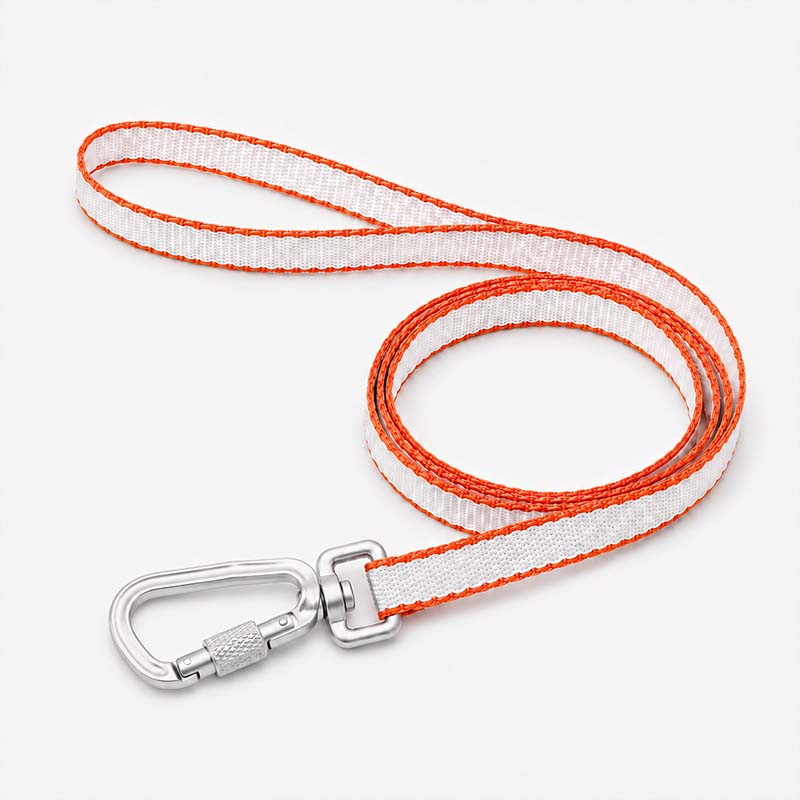
    The FeatherStrong Ultralight UHMWPE Dog Leash uses 10 mm-wide, 2.8 mm-thick webbing and an Aircraft-Grade Aluminum clip. It is available in White & Orange and White & Green.

    Length option Use and measurement notes
    49 cm close control; this measurement excludes the metal clip.
    1.5 m / approximately 5 ft everyday walking with closer handling.
    1.8 m / approximately 6 ft more walking room where the surroundings allow it.

    See our dog leash length guide for more help. This is a single-dog walking model, not climbing, lifting, fall-arrest or unattended tie-out equipment. No finished-product maximum dog-weight or load rating is currently published for this model.

    Sources explain general fiber and rope-care principles; they do not imply that Avient or Samson supplied, tested or endorsed this SOLISZEN product.

  • How Long Should a Dog Leash Be? 3 ft vs 5 ft vs 6 ft

    For everyday walks, start with a 1.5–1.8 m dog leash, approximately 5–6 ft. A 90 cm leash, about 3 ft, can be useful when you need your dog close beside you, provided it reaches the attachment point without pulling tight. Choose the length around your route, your dog’s height, and your handling comfort.

    If you are comparing 90 cm with 150 cm, the main difference is working room: 90 cm keeps the distance compact, while 150 cm allows more slack for ordinary walking. A 180 cm option adds another 30 cm of room. Here is how to choose between them.

    Dog leash length at a glance

    LengthUseful forMain tradeoff
    49 cm / 19.3 in (Ultralight short option)Brief close-control handling when the reach fitsWebbing-only measurement; clip excluded. Much shorter than 3 ft.
    90 cm / about 3 ftShort transitions, busy entrances, and close walkingLess room to sniff; may be too short for a small dog and tall handler
    150 cm / about 5 ftEveryday neighborhood walks and mixed routesEnough slack for walking, but still needs shortening near hazards
    180 cm / about 6 ftQuieter paths, more sniffing room, and loose-leash practiceMore loose leash to manage around feet, other dogs, and obstacles
    Metric measurements are the specified lengths. 49 cm = 19.3 in; on the Ultralight model this is webbing length excluding the clip. Feet are approximate conversions: 90 cm = 2.95 ft, 150 cm = 4.92 ft, and 180 cm = 5.91 ft. The 90 cm row is a general comparison, not a listed Ultralight size.

    The Edmonton Humane Society recommends a 4–6 ft leash for everyday neighborhood walks. That makes 1.5 m and 1.8 m practical starting points. A shorter leash serves a more specific purpose.

    When a 90 cm leash makes sense

    A short leash can be convenient between the car and a building, while waiting at a crossing, or when passing through a busy entrance. There is less spare length to gather while your dog stays close.

    Check the fit of that working distance before choosing it for a whole walk. With your arm relaxed and your dog beside you, the leash should reach the collar or harness with some slack. If you have to lower your shoulder, bend toward your dog, or keep the leash taut, choose more length.

    A 90 cm leash is therefore not automatically a better choice for a small dog. A tall person walking a short dog can need more length than someone walking a much taller dog.

    49 cm short dog leash vs. 5 ft and 6 ft options

    Choice or distinctionWhat to compare
    49 cm short leash

    A 49 cm (19.3 in) short dog leash is substantially shorter than a 90 cm (about 3 ft) leash. On the FeatherStrong Ultralight model, 49 cm is the webbing measurement and excludes the metal clip. It is not a 3 ft option, and 90 cm is not a listed standard length for this model.

    Standard lengths and measuring endpoints

    Compare measurement definitions before ordering. A webbing-only measurement and an overall measurement including hardware are different. The distance available between your hand and the dog’s attachment point also depends on where you hold the handle. If the shortest option cannot reach comfortably with some slack, compare 1.5 m or 1.8 m instead.

    Separate short leash vs. second handle

    A separate short leash is also different from a traffic handle sewn into a longer leash. The first gives you a fixed short connection; the second is an additional grip on a leash that still has its full walking length. Check the actual construction rather than assuming that a product described as a traffic leash has two handles. The Ultralight model has a single loop handle; its 49 cm version does not extend to 5 ft or 6 ft.

    150 cm vs 180 cm: choosing an everyday leash

    LengthWhen it may help
    150 cm / approximately 5 ft

    Choose 150 cm if your usual route mixes sidewalks, crossings, and smaller open areas. It offers room for a relaxed walk without quite as much spare length to gather as 180 cm.

    180 cm / approximately 6 ft

    Choose 180 cm if you often walk on quieter paths and can comfortably manage the extra slack. It gives your dog a little more room to change pace or investigate a scent without you following every step.

    Neither length needs to stay fully extended throughout the walk. Gather a comfortable amount before approaching traffic or passing other people, then allow more room when the surroundings permit it. Keep loose loops clear of feet and wheels.

    Planning to jog with your dog? Compare length by stride and slack management, then read our running leash and Canicross guide to distinguish ordinary handheld jogging from a pulling-sport setup. A longer fixed leash alone does not provide a bungee line or running belt.

    Does a shorter leash stop pulling?

    No. A shorter leash limits how far a dog can move away, but it does not teach loose-leash walking. Constant tension can leave both of you uncomfortable. A longer leash also needs careful handling: allowing a dog to rush to its end can produce a sudden jolt.

    Practice in a quiet place and reward walking with slack in the leash. The American Kennel Club’s leash-training guide explains how to build this skill gradually. If your dog frequently lunges or is difficult to manage, work with a qualified reward-based trainer on an appropriate setup and training plan. For equipment choices during practice, see our training and loose-leash walking guide, covering grip, clip fit, and usable slack.

    For a large dog, choose a length you can handle while keeping enough distance from distractions. Body size alone does not make 90 cm the right answer.

    Length, width, and strength are different decisions

    Length controls working distance. Width affects how the leash feels in your hand. The material, construction, stitching, and clip all contribute to how the finished leash performs.

    UHMWPE stands for ultra-high-molecular-weight polyethylene. It is a fiber material used where high strength relative to weight matters; Avient describes its fiber properties here. Those material properties help explain why a leash can have a slim profile, but they do not establish a finished leash’s load rating.

    A 10 mm leash should not be classified as small-dog-only from its appearance. Equally, width alone cannot confirm suitability for a powerful dog. Check the particular model’s intended use, construction, and handling comfort. A slim strap that feels light when slack may feel quite different in your hand under tension.

    The FeatherStrong™ ultralight leash by SOLISZEN uses slim UHMWPE woven webbing. Hardware material: Aircraft-Grade Aluminum. This combination keeps bulk low, while the webbing’s wear resistance is a useful material feature for everyday walking. Check that the clip fits the collar or harness attachment ring and closes fully, and compare each model’s construction and dimensions.

    Compare current SOLISZEN options

    White and orange FeatherStrong UHMWPE dog leash; clip material: Aircraft-Grade Aluminum
    The FeatherStrong ultralight leash uses 10 mm UHMWPE webbing. Select the length on the product page.

    Before attaching either, check your dog’s collar fit. Our dog collar measuring guide explains how to measure, read a size chart, and check the fitted collar.

    Need a custom leash length?

    If the standard lengths do not suit your walking setup, you can request a custom FeatherStrong leash length. Choose a length that gives your dog appropriate working room and feels manageable in your hand.

    Use the custom sizing request guide to define the endpoints and units. Then email wendy.soliszen@gmail.com with the product name or link, your requested length and units (cm/in or m/ft), and your delivery country. Specify whether you mean the webbing length or the overall length including the clip and handle. We’ll confirm the available options, pricing, and lead time before you order.

    Common questions about leash length

    Is 150 cm the same as a 5 ft leash?

    It is approximately 5 ft. The exact conversion is 4.92 ft; similarly, 180 cm is approximately 6 ft. Use the manufacturer’s stated metric measurement when comparing closely sized products.

    Which length is better for a puppy?

    Start with enough length for slack and a clip that suits the puppy’s attachment ring and size. A lightweight everyday leash around 1.5–1.8 m is a useful option to consider. The shortest leash is not necessarily the easiest or most comfortable.

    Can I use 180 cm for recall training?

    You can practice very short check-ins, but 180 cm is still an everyday walking length. For recall at a distance, use a purpose-built long line in a suitable open area and learn how to handle it safely.

    Do I need more than one leash?

    Only if different walks call for different equipment. Start with the length that suits your most frequent route. A separate short leash can be useful for specific transitions; it does not have to replace your everyday leash.

    Explore SOLISZEN dog leashes and compare the length, webbing, clip, and handle before choosing.